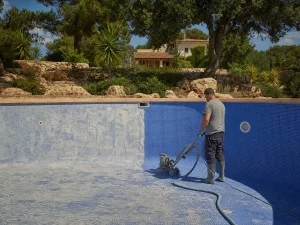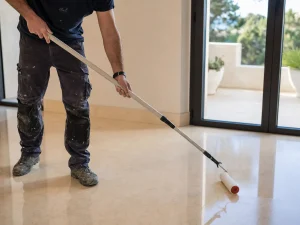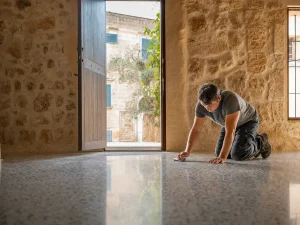
Anti-slip flooring treatment transforms slippery surfaces into safe ones, without construction work or replacing the existing flooring. It is applied to swimming pools, terraces, stairs, bathrooms, and wet areas using chemical methods (which create micropores for grip) or mechanical bush hammering for natural exterior stone. The Spanish Building Technical Code (CTE) requires Class 3 slip resistance for swimming pools and outdoor areas. The price ranges from €24 to €40 per square meter. At Projectes Sastre, we apply it on-site throughout Mallorca, with a free quote.
A slippery floor is an accident waiting to happen, and in summer, with pools and terraces in full use, the risk skyrockets. The good news: there's no need to lift or replace the flooring. With a professional anti-slip treatment, the same pavement becomes safe in a single day Projectes Sastre we have been treating floors across the island for over 50 years, and here we explain what solution yours needs.
What is an anti-slip floor treatment and when do you need it?
An anti-slip treatment is an intervention that increases a floor's slip resistance to prevent falls, without altering its use or requiring replacement. It's especially noticeable when the floor is wet, which is when it really matters.
You need it if you have a surface that becomes slippery in common risk situations: the edge of a swimming pool, a terrace that gets wet from rain or irrigation, a polished stone staircase, a hotel bathroom or changing room, or the entrance to a business when it rains. If you've ever noticed that "that floor is slippery," you've already been warned. You don't have to wait for a fall.
It is a service especially in demand by hotels, homeowners associations and individuals with swimming pools, particularly in the lead-up to the season, when the safety of customers and neighbors is a priority.
What anti-slip treatment methods exist and which one is right for your floor?
There are two main ways to create a non-slip floor, and the choice depends on the material and whether it is for indoor or outdoor use:
- Surface chemical treatment. This product reacts with the floor, opening invisible micropores that increase grip without leaving a residue or altering its appearance. Ideal for stoneware, porcelain, marble, or terrazzo. It's invisible, but you'll feel it under wet feet.
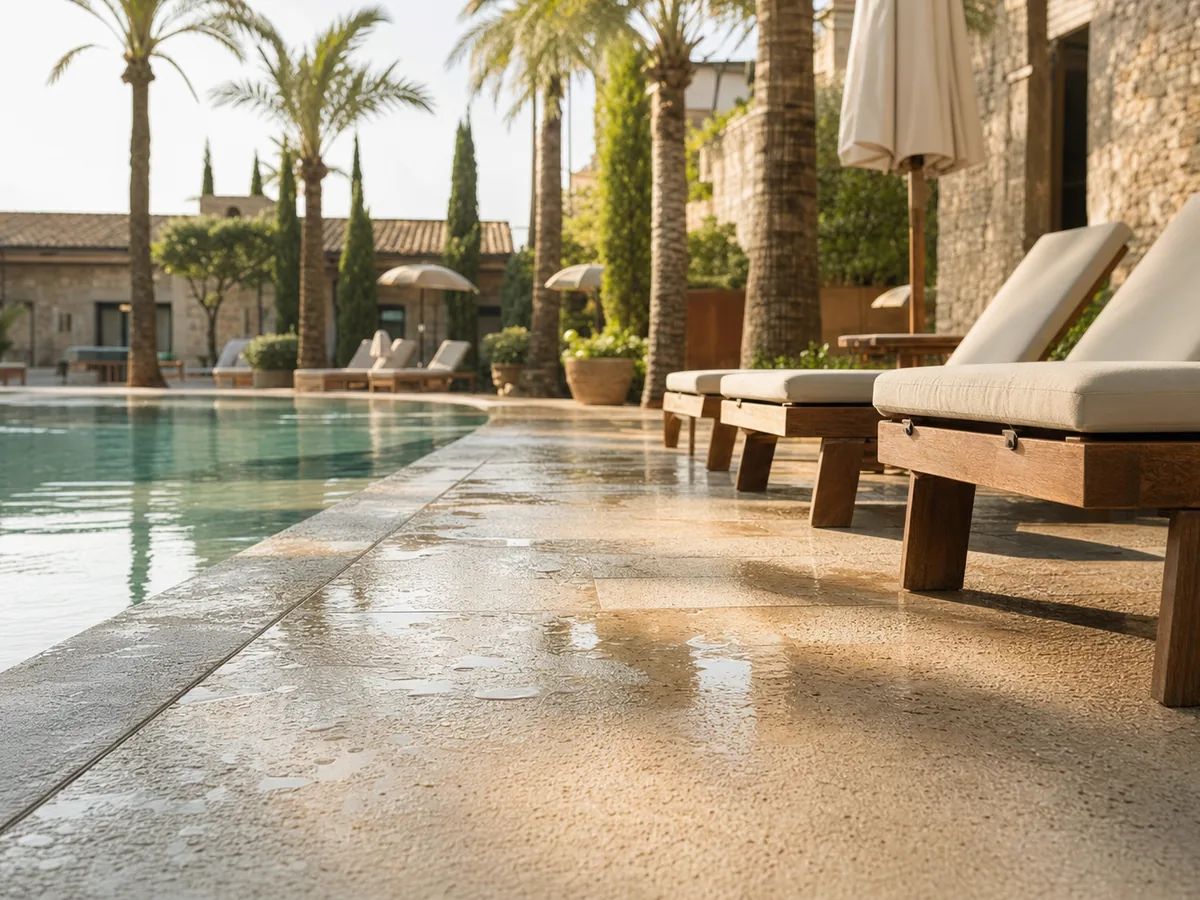
- Mechanical bush hammering. For natural stone used outdoors, the surface is textured mechanically to create a rough, non-slip finish, which is then protected with a water- and oil-repellent treatment. This is the most durable solution for pool surrounds and stone terraces.
On the exterior natural stone, our Floor bush hammering service in Mallorca it is the preferred option due to its durability. For interior marble or terrazzo floors, however, a chemical treatment or a floor crystallisation with a non-slip finish. The important thing is not to apply the same method to everything: each floor requires its own.
For which surfaces and areas do we apply the anti-slip treatment?
We apply anti-slip treatment to all areas where the floor gets wet and the risk of slipping is high. This table summarizes the solutions according to the type of floor and the area:
| Zone / floor type | Risk | Required CTE Class | Recommended solution |
|---|---|---|---|
| Pool surround in natural stone | Very high (wet) | Class 3 | Mechanical bush hammering + waterproofing protector |
| Terrace or porch made of stoneware or porcelain tiles | High (wet exterior) | Class 3 | Chemical anti-slip treatment |
| Interior marble or terrazzo (entrances, bathrooms) | Medium | Class 2 | Anti-slip chemical or crystallised treatment |
| Stairs and ramps | High | Class 2-3 | Chemical treatment with reinforcement in footprints |
| Hotel showers and changing rooms | Very high | Class 3 | Treatment for permanently wet areas |
In natural stone, it is also advisable to combine the non-slip finish with the Maintenance of natural stone floors in Mallorca so that it can withstand salt air and humidity.
What is the step-by-step anti-slip treatment process?
The anti-slip treatment is applied on-site, without construction work, and in most cases the floor can be walked on again the same day. The process is quick but has its method:
- Floor assessment. We assess the material, the condition, and the level of risk in the area.
- Test in a small area. We check the result and the grip before treating everything.
- Thorough pre-cleaning. The floor must be clean for the treatment to adhere.
- Application of the appropriate method. Chemical for coatings, bush hammered for exterior stone.
- Clarification and grip control. We verified the achieved slip resistance.
- Putting into use. In chemical treatments, the area can be used again in a few hours.
No rubble, no changing the floor, and no closing the business for days: that's the advantage of treating instead of renovating.
What does the CTE regulation say about the slipperiness of floors?
The Technical Building Code classifies floors into four classes according to their slip resistance (Rd), requiring the highest rating in high-risk areas. It is the legal standard that any hotel, community, or business premises must meet.
According to the SUA Basic Document of the Technical Code, The classes are: Class 0 (Rd ≤ 15), Class 1 (15 < Rd ≤ 35), Class 2 (35 < Rd ≤ 45), and Class 3 (Rd > 45, the maximum). The standard requires Class 3 in outdoor areas, swimming pools and showers; Class 2 in damp indoor areas such as entrances, bathrooms, or kitchens; and Class 1 in dry indoor areas. You can find more details on the official website of Technical Building Code.
That's why a properly applied anti-slip treatment isn't just a matter of safety: it's what brings your floor up to code. A kit you buy and apply yourself won't guarantee you'll meet the required safety standards; a professional service will.
How much does a non-slip floor treatment cost?
The price of an anti-slip treatment ranges from €24 to €40 per square meter, depending on the type of flooring, the application method, and the desired surface roughness. Chemical treatment of porcelain tiles is at the lower end of the price range; bush-hammered natural stone or a Class 3 pool finish are at the higher end.
What affects the price is specific: the total surface area (the larger the area, the better the price per square meter), the initial condition of the floor, the necessary treatment method, and the accessibility of the area. Compared to the cost of replacing an entire floor with a non-slip one—including construction work, materials, and closure days—treating the existing floor is much more economical. As a market reference, portals such as Habitissimo these jobs fall into that same category. We'll give you a fixed price after seeing the floor.
Why choose Projectes Sastre for your anti-slip treatment in Mallorca?
Because we apply the treatment on-site, using the correct method for each type of flooring and guaranteeing the result—something a DIY product simply can't offer. Over 50 years of experience treating floors in Mallorca have taught us that each surface requires its own specific solution: the stone around a pool is not the same as the marble in a doorway.
We work for hotels, homeowners' associations, restaurants, and private individuals across the island, understanding the urgency of the season: we know a hotel can't afford to close its pool for a week. Free quote, fixed price, and coverage throughout Mallorca. And if your project involves natural stone exteriors, we add our expertise in bush hammering, which provides the most durable, non-slip finish.
Request a quote for your anti-slip treatment in Mallorca
If you have a slippery pool, terrace, stairs, or bathroom, don't wait until it's too late. We'll assess the situation, advise you on the necessary solution, and provide a no-obligation, fixed price quote. At Projectes Sastre, we offer anti-slip treatments throughout Mallorca, backed by over 50 years of experience. Call us at 971 503 936 or write to info@projectessastre.com and we'll sort it out before the season.
Frequently asked questions about anti-slip floor treatments
Is it possible to make a slippery floor non-slip without replacing it?
Yes. A non-slip treatment works on your existing flooring, increasing its grip without the need to remove or replace it. For coverings like stoneware, porcelain, or marble, a chemical treatment is applied that opens micropores; for natural exterior stone, mechanical bush hammering is used. In both cases, the floor maintains its appearance and function, and only one thing changes: it stops being slippery when wet.
What type of slip resistance does the CTE require for swimming pools and outdoor areas?
The Spanish Building Code requires Class 3—the highest level, with a slip resistance (Rd) greater than 45—in outdoor areas, pool surrounds, and showers. In damp interiors such as bathrooms, kitchens, or entrances, it requires Class 2, and in dry interiors, Class 1. A professional anti-slip treatment is applied precisely to achieve and guarantee the class required by the regulations for each area.
Does the anti-slip treatment require construction work or can you walk on it immediately?
No construction work is required. It is applied directly to the existing surface without debris or lifting the pavement. With chemical treatments, the area can be walked on again within a few hours, often the same day. Bush-hammering, being a mechanical process, requires slightly more work but also doesn't involve any major renovations. This makes it the ideal option for hotels, residential communities, and businesses that cannot afford to close for days.
How long does a non-slip floor treatment last?
It depends on the method and its use. Mechanical bush hammering of natural stone is practically permanent because it alters the material's texture. Chemical treatments last several years, depending on traffic and maintenance, and are easily renewable when they lose their adhesion. During the visit, we'll advise you on the most durable solution for your specific situation and how to maintain it in good condition.