Floor restoration in Mallorca
We bring back the original floors of Palma's old buildings, village houses and older apartment blocks without lifting a single tile: the same floor, clean, repaired and protected for many more years.
- Since 1972 in Inca
- Three generations
- Free visit and quote

In short
Restoring a floor means giving an old floor back its colour and protection without replacing it: it is cleaned and stripped, joints and tiles are repaired, it is polished or lightly ground depending on the material, and then sealed. Projectes Sastre has been restoring hydraulic tiles, terracotta, stone, marble, terrazzo and staircases across Mallorca since 1972. In 2026, polishing costs €10-25/m², and hydraulic tile restoration is quoted per project, from around €700.
Why Projectes Sastre
Every old floor, with the technique it needs
-
01
Not everything gets polished
Hydraulic tiles are ground down just enough to keep the pattern; terracotta is stripped and sealed; marble and terrazzo are polished with diamonds.
-
02
Without grinding too much
If stripping and sealing is enough, we'll tell you and won't suggest polishing: on an old floor, whatever is ground away never comes back.
-
03
The original tiles stay
We secure loose tiles and only replace the broken ones, so the floor is still your home's own floor.
-
04
Our own team and machinery
Polishers for every material and rotary machines for stripping, from our workshop in Inca. We see every job through, from an entrance hall to a whole country estate.
Restoration by type of floor
Hydraulic tiles and terracotta aren't treated like marble: each has its own process, timing and finish.
-
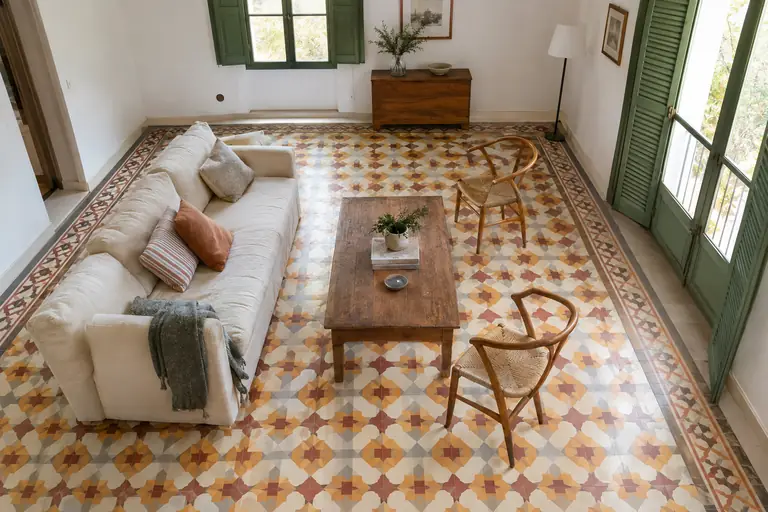
Hydraulic tile restoration
Minimal grinding with fine diamonds and a matt or satin seal: the colour comes back without losing the pattern.
-
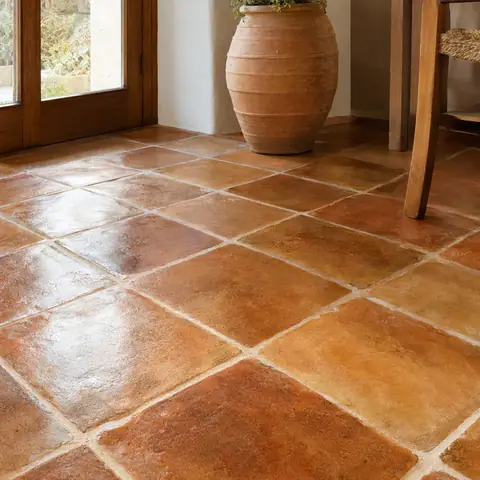
Terracotta floor restoration
Old wax stripped, loose tiles secured or replaced, and a seal of linseed oil, wax or water repellent.


Old stone and staircases
Old stone. The flagstones of Palma's entrance halls, and the marés and Santanyí stone of patios, porches and outdoor stairs, are cleaned without damaging the pores and only ground down if needed. Then they are protected with a water repellent, which is what helps the stone stand up to the island's salt air and damp. As well as polishing, we do honed, bush-hammered and antiqued finishes, indoors and outdoors.
Marble and terrazzo stairs. We fill joints and pores and polish each step, with a small machine and by hand on nosings and corners. Use decides the finish: on stairs a satin finish usually works best, as it doesn't glare and better hides the marks of foot traffic.

Marble, terrazzo, granite and concrete are restored by polishing
In these materials the wear is in the top layer: polishing reveals sound material and the floor is flat and shiny again.
-
Marble polishing
Scratched, with water rings or dull: diamonds from coarse to fine, then crystallisation, which brings back the mirror shine.
-
Terrazzo polishing
The floor of 1960s and 70s apartments: grinding, filling the open joints and crystallisation or vitrification as the finish.
-
Granite polishing
The hardest stone: 4 to 6 diamond passes, down to a fine grit, because granite can't be crystallised.
-
Polished concrete
Garages, warehouses and shops: we polish the concrete you already have and protect it with a lithium treatment, which hardens and waterproofs it.
Restore or replace the floor?
If the floor is stone, terrazzo, hydraulic tile, terracotta or concrete and still intact, restoring it almost always pays. There's no building work or rubble, it takes a few days, and you keep a material that would cost a lot to replace today: a new hydraulic tile floor costs around €129/m², without counting the removal of the old one, and you can't always find the same pattern.
Replacing it only makes sense when the floor is broken in many places, there's a structural problem underneath or damp in the base hasn't been dealt with. We can see that on the visit. We compare both options in more detail in polishing or replacing the floor: when each option makes sense.

How we restore an old floor, step by step
The order is the same for all materials; what changes is the tool and the finish.
- 01
Floor assessment
We look at the material, the built-up wax, the joints, loose tiles and damp in the base, and from that we decide on the treatment.
- 02
Protection
We cover furniture, skirting boards and doors, and take responsibility for any damage.
- 03
Cleaning and stripping
We remove the old wax and dirt, which is what dulls the colour most, and treat the stains.
- 04
Repair
We fill open joints, fill pores and cracks, and secure or replace loose tiles.
- 05
Polishing or grinding
Coarse to fine diamonds on marble, terrazzo and granite, and minimal grinding on hydraulic tiles. Terracotta isn't polished: it is left to dry for about 24 hours before sealing.
- 06
Finish and protection
Crystallisation, vitrification, matt sealing, linseed oil or water repellent, depending on the material. We clean up and explain how to look after it.
How much does it cost to restore a floor in Mallorca?
It depends on the material and its condition. These are guide prices for each job; we give you a fixed price after seeing the floor.
| Service | 2026 price |
|---|---|
| Hydraulic tile restoration | Per project, from around €700 |
| Terracotta floor restoration | After seeing the floor: depends on the wax and the tiles |
| Marble polishing | €10-25/m² |
| Terrazzo polishing | €10-20/m² |
| Polishing granite or concrete | €12-25/m² |
| Crystallisation on top of polishing | +€2-4/m² |
| Vitrification on top of polishing | +€3-6/m² |
| Filling joints in old terrazzo | +€0.50-1/m² |
| Buffing marble or terrazzo | €6-10/m² |
Guide prices for 2026. In hotels and apartment buildings over 300 m², marble or terrazzo polishing drops to around €9-10/m². Buffing granite costs €8-12/m².
What people ask us
Frequently asked questions about floor restoration
Any other questions? Tell us what kind of floor you have and we'll get back to you, with no obligation.
WhatsAppHow much does it cost to restore a floor in Mallorca?
It depends on the material. In 2026, polishing terrazzo costs €10-20/m², marble €10-25 and granite or concrete €12-25. Hydraulic tiles are quoted per project, from around €700, and terracotta once we've seen how much wax has to be stripped. Crystallisation adds €2-4/m² to the polishing, and vitrification €3-6.
How long does it take to restore a floor?
It depends on the size, the material and its condition. As a guide, 100 m² of terrazzo is polished in 2 or 3 days, and marble or granite in 3 or 4; if the marble is crystallised, 4 or 5. With vitrification it's 5 to 7 days, including drying. The entrance hall of an apartment building is usually done in one or two days, and terracotta also needs about 24 hours to dry before it is sealed.
Can an old floor be restored without lifting it?
Yes, in most cases. What dulls an old floor is usually built-up wax and wear in the top layer, not the material: stripping or polishing reveals sound stone, terrazzo or terracotta. Loose tiles are secured and only broken ones replaced, so the floor is still the original.
What is the difference between polishing, buffing, and restoring?
Polishing means grinding away the worn layer with diamond discs until the floor is flat, without scratches or water rings. Buffing brings back the shine without grinding the floor down: it works as maintenance between polishes, but doesn't remove scratches or water rings; you'll find it under floor buffing. Restoring is the full job on an old floor: cleaning and stripping, repairing joints and tiles, polishing or light grinding, and a protective finish.
Can a marble or terrazzo staircase be restored?
Yes, step by step and without replacing any: joints and pores are filled and each tread is polished with a small machine and finished by hand. A flight of four storeys takes 2 to 4 days. In an apartment building we work in halves, so residents always have a way through, and we usually finish in satin, which doesn't glare.
What maintenance does a restored floor need?
Mop with water and neutral soap, never acids or spirits of salt, and sweep often, because sand scratches like sandpaper. The finish is renewed when it loses its shine: in a home, buffing lasts 12 to 24 months and crystallisation 2 to 3 years; in entrance halls, hotels and shops, less. Terracotta and hydraulic tiles are resealed every few years in high-traffic areas.
Do you restore floors in Palma?
Yes. In Palma we mainly restore the hydraulic tiles and marble of the old buildings in the centre, in the Old Town, Santa Catalina, Es Jonquet or El Terreno, and the terrazzo of 1960s and 70s apartments. In the centre we protect the entrance and stairs, keep access clear for residents and clean up at the end of each day. We cover the whole island from Inca.
Related services and guides
Our work, your best guarantee
Is your floor worth saving?
Tell us what floor it is and how many square metres. We'll come and see it and tell you honestly what can be saved and what would need replacing.
- 971 50 39 36
- info@projectessastre.com
- C/ General Weyler, 29, 07300 Inca (Mallorca)
- Monday to Friday, 8:30 am to 4 pm