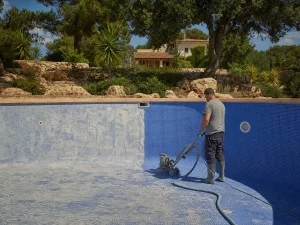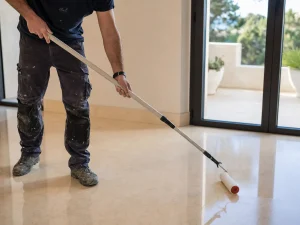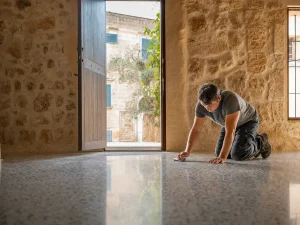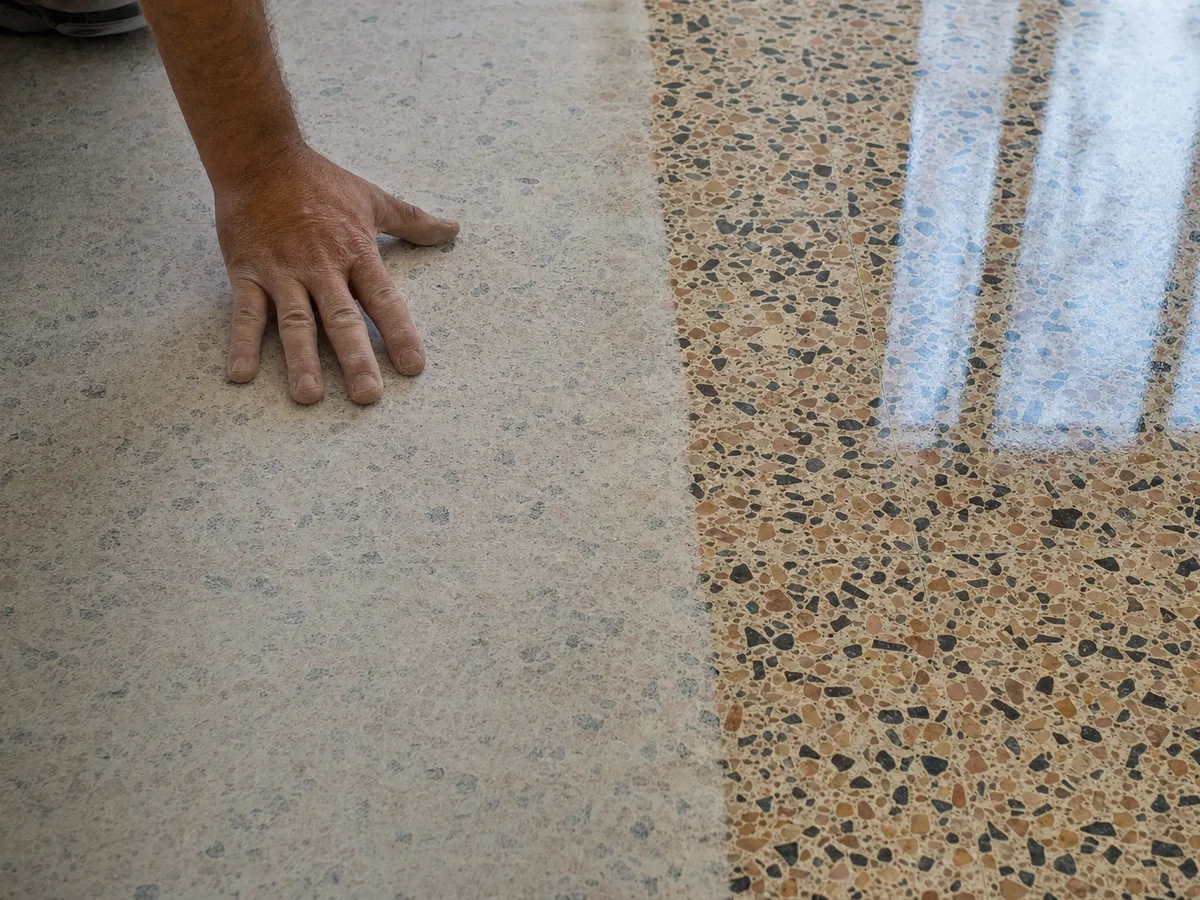
Terrazzo polishing restores the original shine to a worn floor by taking off one to two millimetres of surface with diamond discs, and in Mallorca it costs between €10 and €20/m² in 2026. It brings back the colour, removes scratches and ring marks, and levels the surface. It does not repair broken or lifted tiles, and the result depends on how much cement paste the floor still has above the aggregate.
In Mallorca, terrazzo is found beneath half the island. Townhouses, apartments from the sixties and seventies, community entrances, schools: almost everything built before ceramic tiles arrived was made with terrazzo. According to the Population and Housing Census of the INE, more than half of the residential building stock in the Balearic Islands was built before 1990, which is precisely the era of terrazzo, and a good part of those floors are still there, hidden under layers of wax, supermarket products and thirty years of mopping.
We've been peeling back that layer for over half a century. And what appears underneath is always surprising, because the terrazzo of that era was made with good aggregate and thicknesses that are unseen today.
Why does a terrazzo floor lose its shine over the years?
A terrazzo floor loses its shine because the layer of cement paste covering it opens up with use. Sand tracked in from the street acts like sandpaper under shoes, the pores open, dirt gets inside and mopping no longer brings it out. From that point on, the mop spreads the dirt instead of removing it.
What almost nobody knows is that most of the products sold to "buff" terrazzo make the problem worse. They are acrylic waxes: they give a shine for a month, then yellow and form a film that traps dirt. When we arrive at a house where they have been applying wax for ten years, the first thing we do is not polish, it is strip.
Mallorca's water adds its own unique characteristics. It's hard, it leaves limescale — consumption and quality data by municipality are published in the Institute of Statistics of the Balearic Islands—and in coastal areas, the salt air comes in through the windows and stays. Here, the wind blows from the sea almost all year round, as reflected in the wind patterns published by the State Meteorological Agency. That's why a terrazzo from Palma and one from Portocolom, even with the same age, don't age the same.
What does terrazzo polishing fix and what doesn't it fix?
Polishing terrazzo floors corrects what is on the surface: scratches, ring marks from pots and furniture, rust stains, unevenness between tiles and the general loss of colour. By taking down the whole surface, the joints stop being noticeable underfoot and the floor becomes continuous again. If the terrazzo is in a public entrance hall or staircase, it is also worth checking the slip resistance class required by the Basic Document on Safety of Use and Accessibility.
It doesn't fix broken, cracked, or loose tiles caused by moisture, nor does it remove stains that have penetrated to the aggregate, such as very old oil. It also doesn't change the design: if the terrazzo is fine-grained and sand-colored, it will remain so, only cleaner and shinier.
There is a physical limit worth understanding before hiring anyone. Terrazzo has a wear layer of about 5 to 8 millimetres above the coarse aggregate, and each polishing uses up one or two. A floor can be polished three or four times over its life, not ten. When the aggregate is already flush and the stones look cut, the floor is on its last polishing: it can be done, but you need to know it.
What is the difference between polishing, buffing, and crystallising a terrazzo?
These are three different things, and the order matters. Polishing means taking down material with diamond to correct the surface and remove defects. Buffing means bringing out the shine on a floor that is already smooth, without taking anything down. Crystallisation is a chemical treatment that reacts with the lime in the terrazzo and forms a hard, shiny layer on the surface.
| Treatment | What it does | When to use | Price 2026 |
|---|---|---|---|
| Polishing | Reduces 1-2 mm, corrects scratches and unevenness | Worn, scratched or pitted floor | €10-20/m² |
| Buffing | Brings out shine without taking material down | Smooth but dull floor | 6-10 €/m² |
| Terrazzo crystallisation | Hardens and gives a mirror shine | As a finish after polishing | +2-4 €/m² |
| Vitrification | Apply a protective layer | Floors with high traffic | +3-6 €/m² |
The terrazzo buffing has its own page, because it is not the same thing and it does not cost the same. An expensive and very common mistake is asking for buffing when the floor has scratches. The shine will make them more visible, not less, because the light bounces off the defect. We go into it in the article on the differences between polishing and buffing the floor.
How to polish a terrazzo floor, step by step
- We remove baseboards if necessary and protect doors, frames and fixed furniture.
- We remove accumulated waxes and products, which, if left undone, clog the diamond.
- We grind with coarse grit to level the surface and remove the wear.
- We fill joints and voids with mortar tinted to the tone of the terrazzo.
- We refine with successive grits up to the fine polish.
- We apply the chosen finish: crystallisation, vitrification or natural matt.
A 100-metre home takes us two to three days. We work wet or dry with extraction depending on the house, and in occupied flats almost always dry, so as not to drag slurry down the stairs. We explain both methods in dry or wet floor polishing.
Can terrazzo stairs and baseboards be polished?
Yes, and in residents' associations it is almost always part of the job. The treads are polished with a hand machine, one step at a time, and the risers and skirtings with a diamond angle grinder and a small head. It is slower than flat floor, so it is quoted per linear metre and not per square metre.
In building entrance halls this is the part that shows most: the staircase is the first thing anyone sees on the way in and usually the last thing to be treated. We have a specific page on floor polishing in residents' associations, entrance halls and staircases, where we explain how we organize the work so that residents can continue going up and down.
How much does it cost and how long does it take to polish a terrazzo floor in Mallorca?
Polishing terrazzo in Mallorca costs between €10 and €20/m² in 2026, with a realistic estimate of €12 to €18/m² for average wear and tear, including the finish. Grouting typically adds between €0.5 and €1/m². In large homes, hotels, and apartment complexes, the unit price drops to €9-€10/m² for larger volumes.
To put it in perspective: changing the flooring in that same house costs between €18 and €70/m² plus demolition, debris removal, and two weeks of construction. We have the full breakdown in how much it costs to polish a terrazzo floor in Mallorca, with the ranges by condition of the floor.
Frequently asked questions about terrazzo polishing in Mallorca
Is it worth polishing an old terrazzo floor or is it better to replace it?
In most cases, it's worth polishing. Terrazzo from the 1960s or 70s was made with high-quality aggregates and thicknesses that are no longer used, and for €10-20/m² you can restore a floor that would otherwise cost €18-70/m² plus additional work to replace. It's only worthwhile to replace it if many tiles are broken or lifted, or if the aggregate is already flush after several previous polishings.
How many times can a terrazzo floor be polished?
Between three and four times over its useful life. The wear layer above the coarse aggregate is about 5 to 8 millimetres, and each polishing uses up one or two. When the terrazzo stones look cut and flat instead of rounded, the floor is close to its last polishing. During the visit we check it by measuring at a joint or in a corner.
Is it possible to polish a terrazzo floor without doing any construction work or leaving home?
Yes. Dry polishing with extraction connected to the machine holds the dust in a filter, so there is no debris and no building work: we work room by room and you can carry on living in the house. What you do need is to clear the area and put up with the noise during working hours. Many clients stay, and we agree the order of the rooms with them.
What about the dark grout lines between terrazzo tiles?
They are filled during the polishing with mortar tinted to the tone of the floor, before the fine passes. As the whole surface is taken down at once, the joint ends up flush and practically stops showing. On old terrazzo with very open joints this work adds between €0.5 and €1/m² to the quote, and it is the difference between a polished floor and a floor that looks new.
When NOT to polish a terrazzo
There are three situations where we say no. When there is active rising damp, because the floor will stain again from below and the first thing is to stop the damp. When pieces are missing or many are broken and there is no replacement of the same pattern, because the patch will show. And when the aggregate is already cut flush after several polishings, where sometimes a light buffing works out better than using up the little material that is left.
Request a quote for polishing your terrazzo floor
We will come and look at it with no obligation, we measure and we polish a test patch of one square metre so you can see exactly how your floor will end up before deciding. We cover the whole of Mallorca from Inca, in homes, residents' associations, hotels and commercial premises. Call us on 971 503 936 or write to us at info@projectessastre.com. We are specialists in floor treatment in Mallorca for more than 50 years, and you can see everything we do on our floor polishing service in Mallorca.