Rust and limescale stains can be removed from a swimming pool basin without chipping the tiles or replacing the lining. The surface can be treated with low-pressure sandblasting or mild abrasives, depending on the material. In Mallorca, the cost ranged from €15 to €30 per square meter of treated surface in 2026. This method works on tiles, exposed concrete, natural stone, and microcement, but should never be used on liners or polyester.
When you empty a pool in September, what the water was covering shows up: the white limescale line at the waterline, the orange streaks under the ladder anchors, and the bottom with a film that will not come off with a brush. The normal reaction is to think about replacing the pool tiling.
It's almost never necessary. In most Mallorcan glasses, what's stained is the surface of the material, not the material itself.
Why do rust and limescale stains appear on a swimming pool basin?
They appear for three reasons that are almost always the same in Mallorca. The island's water is very hard, high in calcium carbonate, and as it evaporates, it leaves limescale stains on the waterline of the pool. Metal elements, especially ladder anchors and light screws, rust, and the rust runs down the wall. And the well water used by many properties contains dissolved iron and manganese that precipitate and stain the bottom.
Added to this is the salt air in swimming pools near the sea, which accelerates the corrosion of any nearby metal. That's why a pool in Alcúdia or Portocolom gets dirty faster than an identical one inland: the sea breeze dominates for much of the year, as noted in the State Meteorological Agency.
Lime is white or gray and forms a crust when touched. Rust is orange or brown and usually leaves a trail running down from a specific point. Distinguishing between them is important because the treatment is not the same.
Can they be removed without changing the mosaic tiles or breaking up the pool?
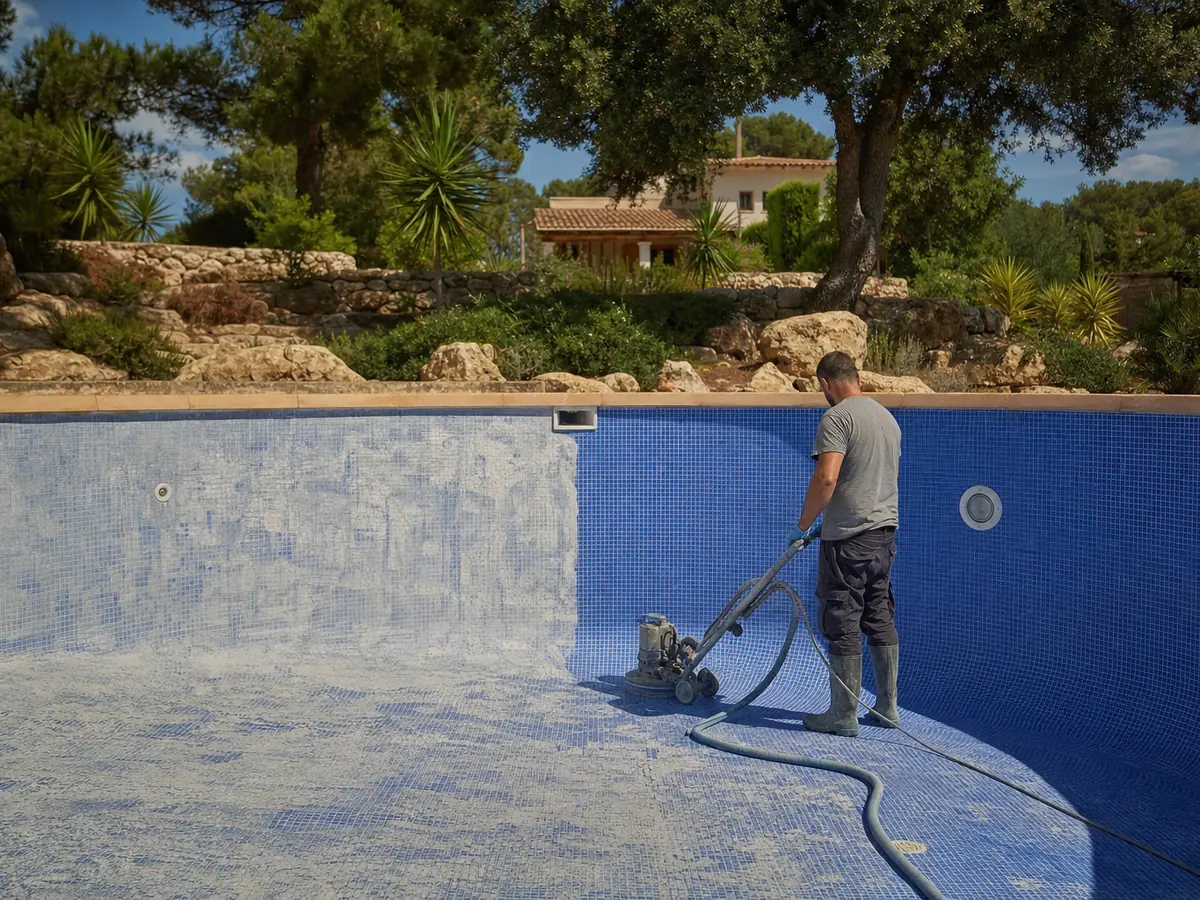
Yes. Rust in the pool basin is almost always on top of the liner, not inside. We don't build or repair pools: we remove what's adhered to the surface without touching the underlying material. Sandblasting in pools is applied at low pressure: it projects the abrasive with just enough force to remove the limescale or rust deposit and stop at the glaze of the mosaic tiles.
The key is that the stain is on the surface, not inside the tile. When you clean the pool tiles with the glaze intact, the limescale comes off completely and the color returns. If the glaze is cracked or missing, the rust has penetrated the bisque, and no treatment will work: that tile has to be replaced, and we'll tell you that during the visit.
Regulating the pressure is the whole point of the job. Too much, and it removes the enamel and grout; too little, and it doesn't touch the surface. It's the same thing we do with the marés stone façades, a soft material where applying the wrong pressure is costly.
What method is used on each surface of the glass?
| Coating | Appropriate method | Expected result |
|---|---|---|
| Gresite and ceramic tile | Low-pressure abrasive blasting with fine abrasive | Limescale and rust are removed; the glaze is preserved |
| Exposed or sprayed concrete | Medium pressure jet | Clean and homogeneous surface, ready to paint |
| Natural stone and marés | Gentle jet with soft abrasive | The tone is recovered without opening the pore |
| Microcement | It doesn't drip; gentle chemical cleaning | Depends on the condition of the sealer |
| Liner and polyester | Never sandblast | The abrasive perforates the liner |
| Stone coping and borders | Gentle blasting, or bush hammering if it is slippery | Cleaning and, if applicable, anti-slip texture |
The liner row is not a recommendation, it is a limit. A liner is a PVC sheet less than one and a half millimetres thick: the abrasive blast puts holes in it in seconds. We have a guide on the surfaces where sandblasting should not be used precisely because this mistake is expensive and frequent.
What the job is like, from emptying the pool to handing it back ready
- We visited the pool with water to see the scope and decide on the method.
- The pool is emptied, a task coordinated by the client or their maintenance person; if the pool is for public use, the emptying and subsequent refilling must comply with the criteria of the Royal Decree 742/2013.
- We protect lights, inlet nozzles, skimmers and elements that are not treated.
- We take a sample of half a meter in a hidden area and show it.
- We treated the glass in layers, from the rim to the bottom.
- We remove the abrasive and the remains, and leave the glass ready to be filled or painted.
A family pool of 8 by 4 metres takes us one to two days of work, plus the draining and filling time, which is not down to us. The best time is October and November, when the pool is no longer in use and the shell can be kept dry without rushing. In spring there is more demand and less leeway.
It's worth remembering that an empty pool has its risks: in areas with a high water table, an empty pool can float. This is something the pool maintenance person will assess, not us.
How much does it cost to clean a swimming pool in Mallorca?
Cleaning a swimming pool basin with sandblasting in Mallorca costs between €15 and €30 per square meter of treated surface in 2026, within the general range of €8 to €30 per square meter for sandblasting, the market average of which is around €15 per square meter. If only the waterline needs to be treated, the price is quoted per linear meter and is considerably cheaper.
| Job | Scope | Estimated price 2026 |
|---|---|---|
| Waterline with lime | Perimeter strip | Per linear meter, from €12/ml |
| Complete mosaic tile vase | Walls and background | 15-25 €/m² |
| Concrete with widespread rust | Walls and background | 20-30 €/m² |
| Coronation and stone beach | Perimeter | 15-25 €/m² |
We have the breakdown of all the materials in our guide to sandblasting prices in Mallorca.
Frequently asked questions about rust and limescale stains in swimming pools
How do you remove rust stains from the mosaic tiles of a swimming pool without replacing them?
Using low-pressure sandblasting with fine abrasive, the process removes the adhered rust deposit and stops at the tile's glaze. The work is done with the container empty and dry, protecting lights and nozzles. This method only works if the glaze is intact: when the tile is cracked, the rust has penetrated the interior of the piece, and it must be replaced.
How much does it cost to clean a swimming pool in Mallorca in 2026?
Between €15 and €30/m² of treated surface, depending on the tile and the type of stain. A mosaic tile pool with moderate limescale and rust costs €15-25/m², and a concrete pool with widespread rust costs €20-30/m². If the stain is limited to the waterline, the price is quoted per linear meter starting at around €12, and the total cost drops significantly.
Can sandblasting be used on a liner or polyester pool?
No, not at all. The liner is a PVC sheet just over a millimeter thick, and the abrasive will pierce it in seconds; the polyester has a gelcoat layer that the blaster will leave permanently matte and porous. On these coatings, stains are treated with specific chemicals and brushing, and sometimes you have to accept that they won't come out completely.
Why do limescale stains reappear every season?
Because Mallorca's water is hard, and when it evaporates from the surface of the pool, it leaves calcium carbonate deposits behind. Maintaining the pH between 7.2 and 7.6 and controlling the hardness significantly reduces the rate at which it appears, but does not eliminate it. The technical and sanitary criteria for swimming pools are set out in the Royal Decree 742/2013, and its monitoring is the responsibility of whoever maintains the facility.
When it is NOT a job for us
If the pool is losing water, has structural cracks or the shell is moving, the problem is not the stain and cleaning it solves nothing: that is a pool builder's job. If the lining is liner or polyester, blasting is ruled out. And if what you want is to replace the whole tiling, that is not us either: what we do is recover what is already there. In residents' association and hotel pools, moreover, the coping and the surround have to meet the slip resistance classes of the Basic Document on Safety of Use and Accessibility.
We tell you this during the visit, free of charge and without beating around the bush. We'd rather not do a job than do it knowing it won't solve the problem.
Request a quote to clean your pool
We will come and look at it, we assess whether the stain is on the surface and we do a test patch so you can see the result before committing to anything. We clean pool shells across Mallorca for private homes, residents' associations, hotels and agritourism properties, from our workshop in Inca. Call us on 971 503 936 or write to us at info@projectessastre.com. We are a sandblast cleaning company in Mallorca with more than 50 years in the trade, and here you have the whole service of sandblasting.