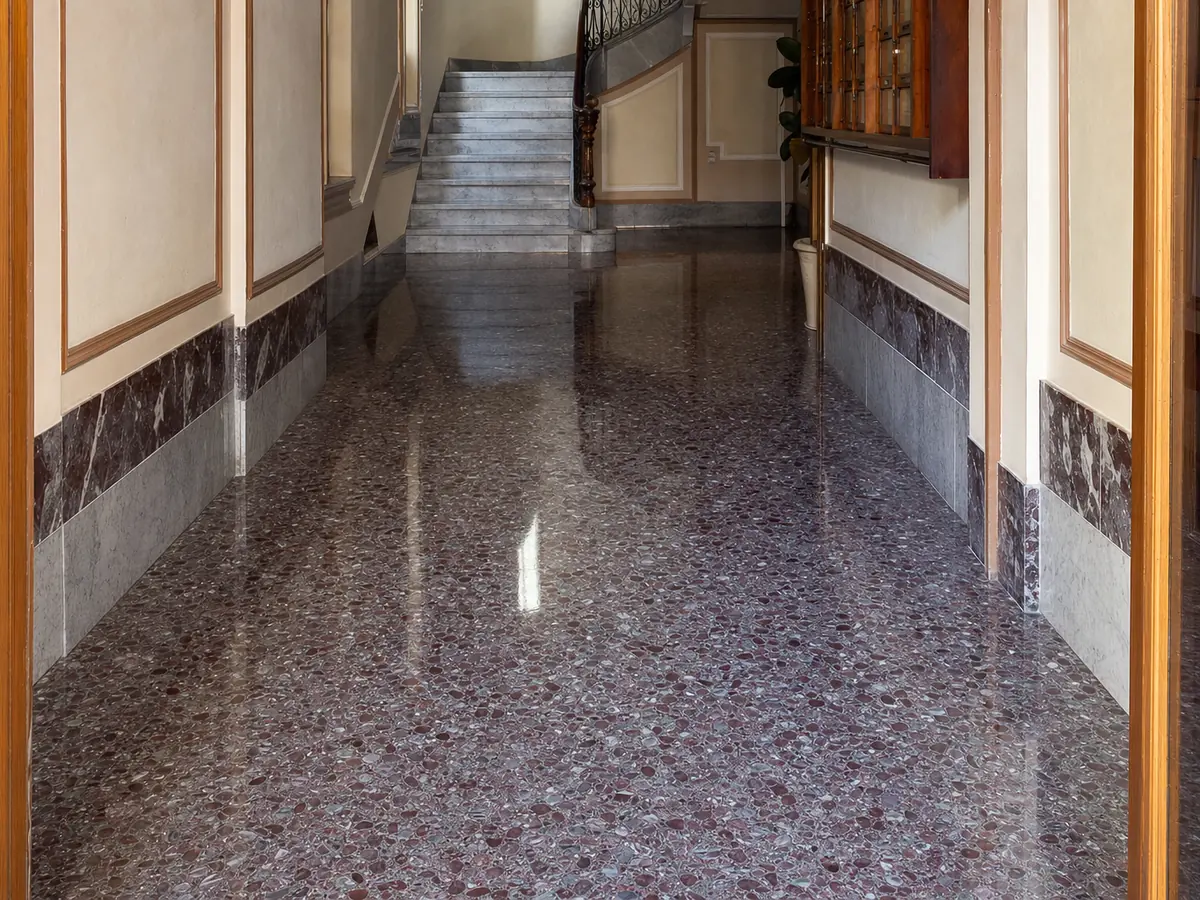
Buffing terrazzo in Mallorca costs between €6 and €10/m² and brings the shine back to a floor whose surface is still sound but looks dull. It does not remove scratches, rings or white stains: that calls for polishing, at €10 to €20/m². With terrazzo, unlike marble, crystallisation and vitrification can both follow. In a communal entrance hall the shine lasts 6 to 12 months.
Underneath half of Mallorca lies terrazzo. The apartment blocks built between the 1960s and 1980s in Palma, Inca, Manacor, and along the coast were almost all constructed with this type of flooring, and sixty years later, most of it remains intact and in good condition. What has disappeared is not the flooring itself: it's the shine.
That is exactly the situation that terrazzo buffing in Mallorca solves. And it is also where most people choose the wrong treatment.
Why does the terrazzo flooring in Mallorca lose its shine so quickly?
Terrazzo loses its shine because its original finish is a micrometric layer of polished surface that wears down with friction, and in Mallorca that friction has a name: sand. Beach sand is silica, and silica is harder than the limestone aggregate of terrazzo. Every step with sand under your shoe acts like fine sandpaper.
Added to that is the second culprit, which almost no one suspects: the mop. Decades of products containing ammonia, bleach, or acidic cleaners gradually eat away at the surface of the terrazzo, which is calcareous and cannot withstand acid. The floor doesn't just scratch suddenly. It dulls.
And there's a third, very Mallorcan, factor: wax. For years everything was waxed, and that accumulated wax oxidises, yellows and traps dirt. A terrazzo floor like that isn't worn, it's just covered up.
What does terrazzo buffing include and what does it not fix?
Terrazzo buffing includes removing old wax and residue, mechanical buffing with steel wool and buffing powder, and going over corners and skirting boards by hand. It is the gentlest step in our floor buffing service. What it doesn't do is remove material, so it doesn't correct anything below the surface.
What it does solve:
- Dull floor, without reflection, with a "washed" appearance.
- Old, yellowed wax accumulated over years.
- Loss of colour in the aggregate, which comes back to life.
- Micro-surface mop scratches.
What it doesn't solve, and you should know this before hiring:
- Scratches you can feel when you run a fingernail over them.
- White damp or acid stains, which are inside the material.
- Open joints or uneven pieces.
- Areas worn down to the aggregate in corridors and entrances.
Everything in the latter requires polishing. It's a fundamental difference that we explain in the differences between polishing and buffing the floor, and it is the one that decides whether your quote stays at €700 or goes up to €1,800.
How much does it cost to buff a terrazzo floor in Mallorca?
Buffing terrazzo in Mallorca costs between €6 and €10/m² as a standalone job. For an 80 m² flat that comes to between €480 and €800. If the floor needs polishing first, the whole job runs between €12 and €24/m², because buffing done straight after a polish only adds €2-4/m² on top of the polishing price.
| Terrazzo condition | Treatment needed | Indicative price |
|---|---|---|
| Dull, sound surface | Buffing | 6-10 €/m² |
| Dull + worn traffic areas | Light polishing + buffing | 12-18 €/m² |
| Scratched, stained or uneven | Full polishing + buffing | 15-24 €/m² |
| Entrance hall or high-traffic area | Polishing + crystallisation | 16-26 €/m² |
An honest note about online pricing: the national price ranges you'll see on comparison sites don't include what really drives up the cost of a job on the island, which is access. A third-floor walk-up in Palma's old town doesn't cost the same as a villa with a driveway. If you want the detail of the full treatment, it is in how much it costs to polish a terrazzo floor in Mallorca.
Buffing, crystallisation or vitrification of terrazzo: which should you choose?
Terrazzo is one of the few floors that takes all three treatments, and choosing the wrong one is what makes a job last six months instead of five years. Buffing gives a mechanical shine. Crystallisation triggers a chemical reaction with the calcium in the terrazzo itself and hardens the surface. Vitrification lays a layer of resin on top that seals the floor completely.
| Buffing | Crystallisation | Vitrification | |
|---|---|---|---|
| What it does | Surface gloss | Hardens it through a chemical reaction | Protective resin layer |
| How long it lasts in a home | 12-24 months | 2-4 years | 5-10 years |
| How long it lasts in an entrance hall | 6-12 months | 1-2 years | 4-8 years |
| Price | 6-10 €/m² | 3-6 €/m² on top of polishing | 8-15 €/m² on top of polishing |
| Appearance | Natural shine | Intense natural shine | Varnish-like gloss |
Our recommendation in Mallorca, after half a century of doing it: private home, buffing or crystallisation; entrance hall, staircase or premises with constant footfall, vitrification. In terrazzo vitrification in Mallorca we explain when that bigger investment is worth it.
One thing to watch out for: vitrification cannot be applied over terrazzo with unresolved rising damp, because it seals the vapour inside the slab and ends up lifting in patches. The Basic Document HS of the Technical Building Code is clear that damp rising from the ground has to be tackled in the substrate. In the ground floors of village houses, this happens more often than you might think.
Can a terrazzo floor with white stains or damp patches be buffed?
Not with a lasting result. The white stains on terrazzo are salts that have crystallised inside the pores of the material, or the remains of an acid attack that has eaten into the surface, and buffing works on top of them. You can put a shine on the floor and the stains will still show, now with more contrast.
The right route is to treat the stain first, polish afterwards and buff at the end. If the cause is active damp, not even that works: you have to stop the water getting in or they will come back. We have the case set out in detail in how to remove white stains from a terrazzo floor, with the most common causes we find on the island.
How do we buff the terrazzo flooring of a building entrance without closing the building?
- Prior visit and agreed schedule with the chairperson or the managing agent.
- Dividing the entrance hall into two halves, always leaving a signposted clear passage.
- Dewaxing and thorough cleaning of the first half.
- Mechanical buffing in cross passes and hand finishing of the perimeter.
- Change of half and repetition of the process.
- Staircase in sections, starting from the top and going down.
- Handover with the entrance hall ready to walk on the same day and no mess left behind.
In an average Palma community, this is resolved in one or two days. The key isn't the machine: it's planning with the community, so that no resident is left unable to access their home. It's the same method we use in the floor polishing in residents' associations, entrance halls and staircases.
What result can be expected from a terrazzo from the 60s or 70s?
Better than people imagine. Terrazzo from that era was made with a thicker wearing layer and good-quality marble aggregate, so there is usually plenty of material to work with. A 1968 terrazzo floor properly polished and buffed looks better than many of today's floors, and in a colour that is no longer made.
What you do have to accept is that it won't look like a brand-new floor. It will have the tone and grain of its era, some replaced pieces will be noticeable, and the grout lines will still be there. That's not a flaw: it's what gives a Mallorcan apartment from that period its character.
And there's a market reason behind the boom in this job. With housing prices in the Balearic Islands at record highs, according to data published by the INE, and with 1,771 renovations approved in Mallorca between January and June 2026, 17% more than the previous year, restoring the original terrazzo instead of replacing it has become one of the jobs with the best ratio of cost to added value. Changing the floor in that flat would cost between five and ten times more, as we compare in polish or replace the floor.
Why hire Projectes Sastre to buff terrazzo?
Over 50 years working terrazzo in Mallorca, with our own team and no subcontractors. We have treated terrazzo in private homes, communal entrance halls, hotels and business premises all over the island, and that gives you something you cannot buy: knowing straight away how much material is left under a floor before touching it.
We also know when to say no. If your terrazzo needs polishing and not buffing, we'll tell you, even if buffing is the cheaper and faster of the two options. That's the approach that defines us specialists in floor treatment in Mallorca and, frankly, that's the reason we're still here.
Frequently asked questions about terrazzo buffing in Mallorca
How much does it cost to buff an 80 m² terrazzo floor in Mallorca?
Buffing 80 m² of terrazzo in Mallorca costs between €480 and €800 if the surface is sound and only the shine needs bringing back. If the floor needs polishing first, the total comes to between €960 and €1,900. The final price depends on the condition, on how accessible the home is and on whether layers of old wax have to be stripped before starting.
How long does the shine of a buffed terrazzo last?
In a private home the shine of buffed terrazzo lasts between 12 and 24 months. In a communal entrance hall or a shop it drops to 6 to 12 months because of the constant footfall. If you want it to last longer it is worth moving up to crystallisation, which holds for 2 to 4 years in a home, or straight to vitrification in high-traffic areas.
Can terrazzo be buffed without polishing it first?
Yes, provided the surface is smooth and has no visible damage. Buffing is a standalone treatment and does not require polishing first. That said, if the terrazzo has noticeable scratches, worn areas or pieces at different heights, buffing without polishing will give a poor, short-lived result, because the shine highlights the flaws instead of hiding them.
Does terrazzo buffing smell or make the house dirty?
Buffing creates fine dust and a slight smell of product while the work is going on, but it is done with extraction and the smell is gone within a few hours. You do not have to move out: we work room by room so you can carry on using the rest of the house. When we finish we leave the floor vacuumed and ready to walk on the same day, with nothing left behind.
How often should the terrazzo flooring in a residential building be buffed?
In a block of flats the recommendation is a maintenance buffing every 6 to 12 months, adjusted to the actual footfall in the entrance hall and how close it is to the sea. Seafront buildings, where sand comes in daily, need the shorter interval. Keeping to that rhythm works out far cheaper than letting the floor deteriorate and having to polish the whole entrance every few years.
When NOT to buff a terrazzo floor
- With active rising damp. Cut off the water first; otherwise any treatment will last weeks.
- If more than 10% of the pieces are broken or lifted. It needs repairing and polishing, not buffing.
- On outdoor or pool-side terrazzo. What matters there is grip, not shine.
- Just before a renovation. Construction dust and the passage of workers will ruin it; leave it for last.
Request a quote for buffing your terrazzo
We come out, look at the floor, tell you plainly whether what you need is terrazzo buffing, polishing or vitrification, and put it in writing. Free and with no obligation, anywhere in Mallorca. Call 971 503 936, write to info@projectessastre.com or send us a photo of the floor from the contact page and we will point you in the right direction before we even come out.