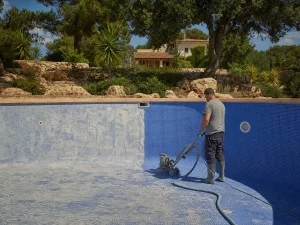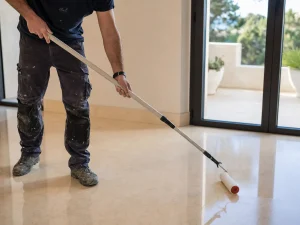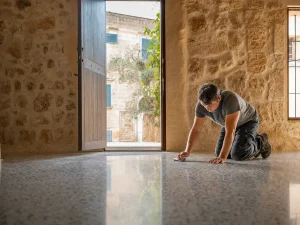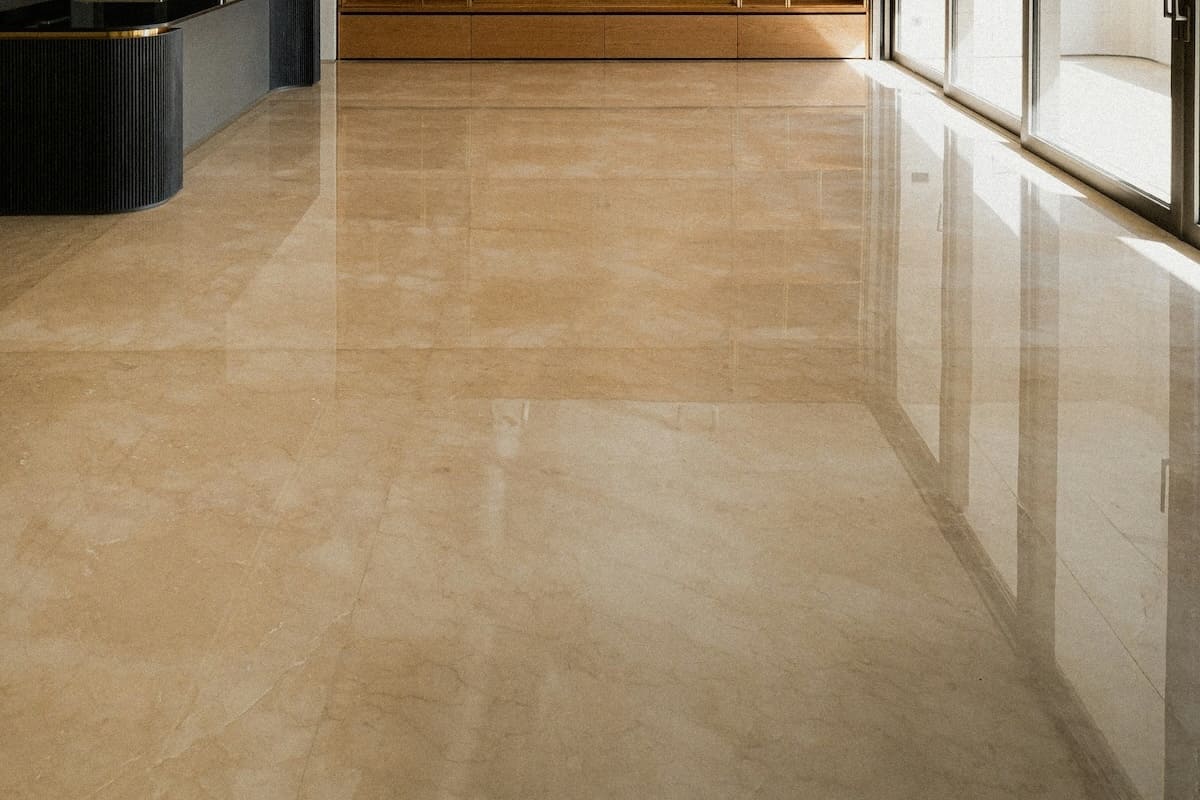
Wet polishing uses water to lubricate the floor, generates no dust, and allows for a very fine finish, ideal for marble, terrazzo, and living spaces. Dry polishing works without water, generates dust (controlled with vacuuming), and is used in situations where the floor cannot be wetted. Diamond polishing is a wet polishing process with a fine finish, and crystallisation is the subsequent high-gloss treatment. For most residential floors in Mallorca, wet polishing is the cleanest and most precise option.
When you're going to polish a floor, one of the technical questions that arises is whether to do it dry or wet. This isn't a minor detail: each method has its own logic, advantages, and ideal situations. Choosing the wrong method can mean more dirt than necessary or a finish that isn't optimal for your floor. We'll explain it clearly, without empty technical jargon, so you understand what's being done in your home and why. It's the difference between a well-planned job and one done haphazardly.
What is the difference between dry polishing and wet polishing?
The main difference is that wet polishing uses water to lubricate the surface during the process, preventing dust and allowing for a finer finish, while dry polishing works without water and generates dust that is controlled by vacuuming. Wet polishing is cleaner and more precise; dry polishing is more versatile in certain situations.
In wet polishing, water does two things: it lubricates the diamond wheel so it doesn't excessively damage the stone and it washes away the removed material, preventing dust from rising. The result is a fine finish and a clean environment. In dry polishing, there is no water, so the friction generates dust, which is now managed with machines that vacuum it up instantly. Each method has its place, and a good professional knows when to use each one. Both are part of the floor polishing in Mallorca that we carry out.
When is wet polishing used?
Wet polishing is used on most residential floors, especially marble and terrazzo, whenever a very fine finish is desired without generating dust. It is the preferred method in living spaces and on delicate floors.
It has several advantages that make it the most common method. Because it doesn't raise dust, it can be used in occupied apartments, offices, or commercial spaces without making a mess, a highly valued feature when the family still lives there. Furthermore, the water protects the stone during the process and closes the pores, leaving an extremely smooth surface, ready for subsequent crystallisation. This is why it's the preferred method for marble and terrazzo, the most common flooring materials in Mallorca. Diamond polishing, which we'll discuss below, is precisely a wet polishing process with a fine finish.
When is dry polishing advisable?
Dry polishing is suitable in situations where the floor cannot or should not be wetted, or in certain specific phases of the work, such as some concrete finishes. It is less common in residential settings and more frequent in industrial or specialized contexts.
There are floors and situations where water isn't desirable: areas where water could seep into lower rooms, floors sensitive to moisture, or projects where a specific finish is desired that is better achieved with dry polishing. It's also used in some phases of concrete treatment. The key is that today's dry polishing machines incorporate powerful dust extraction, so dust is fairly well controlled, although it never achieves the complete cleanliness of wet polishing. It's not inherently better or worse: it's simply the right tool for certain situations. Evaluating which one is appropriate is part of a professional's job Floor polishing and diamond grinding company in Mallorca.
Comparative table: dry polishing versus wet polishing
| Factor | Wet polishing | Dry polishing |
|---|---|---|
| Water usage | Yes, it lubricates the surface | No |
| Dust generation | Minimum | Yes, controlled with aspiration |
| Finish | Very fine, it closes the pores | Well, according to the material |
| Inhabited spaces | Very suitable | Suitable with good suction |
| Typical floors | Marble, terrazzo | Concrete, specific cases |
| Dirt in the home | Very low | Moderate |
The table clearly shows why wet polishing is the most common method used in homes: it combines a fine finish with a clean environment. Dry polishing is preferred in cases where wetting is not an option.
What is the relationship between diamond cutting and crystallisation with each method?
Diamond polishing is a wet polishing process using diamond discs that produces a very fine finish, and crystallisation is the chemical polishing treatment applied afterward. These are distinct phases of the process, not methods that are the opposite of polishing.
It's important not to confuse them. Diamond polishing is actually an advanced step in wet polishing: it uses diamond-coated discs and water to smooth the surface as much as possible, sealing the pores and leaving it ready for finishing. Crystallisation comes after: it's a product that reacts with the calcium carbonate in marble or terrazzo, forming a layer of crystals that provides shine and protection. In other words, you polish or diamond polish (wet) first, and then you crystallise. We explain this in detail in the guide on differences between floor polishing and vitrification. Knowing this helps you understand any budget.
Which of the two methods makes less mess in the home?
Wet polishing is much less messy in the home because the water washes away the removed material and prevents dust from rising. Dry polishing generates dust, although modern machines with vacuum systems reduce it considerably.
For those who continue living in the house during the work, this is crucial. Wet polishing leaves a clean environment, without that layer of fine dust that gets everywhere. It does generate dirty water, but the machinery collects it as it goes. Dry polishing, even with good vacuuming, always leaves some residue suspended in the air. That's why, in occupied apartments in Mallorca, wet polishing is almost always the best choice, unless there's a specific reason not to wet the floor. During the visit, we'll explain which method we'll use in your case and why.
When NOT to choose dry polishing
Dry polishing is not the right option in several cases:
- In inhabited homes where minimal dirt is desired: that's where the damp one wins.
- In marble and terrazzo, where the finest possible finish is sought for crystallisation: the wet method achieves it best.
- When a powerful suction system is not available: without it, dust becomes a serious problem.
The choice of method shouldn't be left to chance or the operator's convenience. It depends on the flooring, the space, and the desired finish. If a company can't explain why they use one method over another, be wary.
Frequently asked questions about dry and wet polishing
Which is better, dry polishing or wet polishing?
It depends on the type of flooring and the situation, but for most homes, wet polishing is better because it doesn't generate dust and provides a finer finish. Dry polishing is reserved for cases where the floor can't be wetted or for certain concrete work. There isn't one universally superior method; there's one that's suitable for each specific situation.
Does wet polishing a floor generate a lot of dirty water at home?
Wet polishing generates water along with the removed material, but modern machinery collects it as it goes, so it doesn't flood the home. It's much cleaner than the dust produced by dry polishing. When finished, the floor is delivered clean and ready to walk on. That's why it's the preferred method for occupied homes.
Is diamond polishing the same as wet polishing?
Diamond polishing is a type of wet polishing, not something separate. It uses diamond-coated discs and water to create a very fine finish, sealing the stone's pores. It's considered an advanced polishing step, prior to crystallisation. In other words, all diamond polishing is wet polishing, but with a more refined finish than conventional polishing.
Is it possible to polish a floor in an inhabited house without making a mess of it?
Yes, with wet polishing a floor can be polished in a home people are living in with hardly any dust, because the water stops it rising. That is one of its big advantages. The work can be organised zone by zone so that the family can keep using the house. If for some reason dry polishing is used, a good extraction machine keeps the dust under control. That is exactly the question we are asked most before starting, and we answer it in full in our guide on how to polish a floor without dust while you keep living at home.
Do you want to polish your floor using the right method?
If you have a floor that needs polishing in Mallorca and you want it done right, using the correct method for your specific situation, let us take a look. We'll explain the best process for your floor and provide you with a free, fixed-price quote. Call us at +34 971 503 936, email us at info@projectessastre.com, or contact us via WhatsApp. We work throughout the island, backed by over 50 years of experience.