A scratched or worn marble floor can almost always be restored. Minor scratches can be softened at home with a specific polishing compound; deep scratches that are noticeable when you run your fingernail over them, and the general loss of shine from foot traffic, can only be truly resolved with professional diamond polishing. Marble scratches easily because it is a soft material (hardness 3 on the Mohs scale). Before spending money, it's important to identify the type of damage: a dull film is not the same as a groove. We'll explain it clearly here, without overselling.
Let's be honest from the start, which is how we work. Some marble damage can be fixed yourself with a cloth and a cleaning product. Other damage, however, can be worsened by home remedies Projectes Sastre we have been polishing marble in Mallorca for over 50 years, and this is what we tell anyone who calls us with a scratched floor: first, see what kind of damage you have.
Why does a marble floor get scratched and worn down with use?
Marble scratches easily because it is a soft stone: it has a hardness of 3 out of 10 on the Mohs scale, while the sand we walk on daily and drag with our shoes is around 7. That is, the dust and grit that comes in from the street are harder than the floor itself, and act like sandpaper every time we walk on it.
Added to this is the dragging of furniture, chair legs, and constant foot traffic in walkways. Over the years, the result is twofold: scratches and micro-scratches appear, and the surface loses its overall shine. This dullness in the most frequently used areas isn't dirt; it's accumulated micro-scratches and actual wear of the polished layer. That's why more cleaning won't fix it: the problem is in the surface, not on top of it.
What type of damage does your marble have: light scratches, deep scratches, or loss of shine?
Before taking action, identify the damage. There's a foolproof trick: the fingernail test. Run your fingernail over the scratch; if it catches, it's a deep scratch; if not, it's superficial. This chart will help you self-diagnose your marble floor:
| Type of damage | How to recognize it | Does it catch on your fingernail? | Solution |
|---|---|---|---|
| Surface mark or veil | Matte or dirty area, without relief | No | Neutral cleaning + microfiber |
| Minor scratch | Very superficial fine line | Barely | Marble polishing paste (homemade) |
| Deep striping | Groove visible to the touch | Yes | Professional diamond polishing |
| Loss of shine due to wear and tear | Passageways dark, general dullness | No | Crystallised; if there is micro-scratching, pre-polishing. |
| Marble that has never been treated or has borders | Uneven texture, worn to the touch | Yes | Complete polishing + crystallisation + sealing |
This gives you a clear idea of what to expect. The first two cases can be handled at home. The last three require professional help.
How to remove a superficial scratch from marble at home step by step?
A light scratch on marble, the kind that barely catches your fingernail, can be softened at home with a polishing compound specifically designed for marble. It's a simple job if the damage is superficial. Follow these steps:
- Clean the area with water and a pH neutral soap, and dry it well.
- Apply marble polishing paste (never kitchen abrasives or metal scouring pads) on the mark.
- Rub in circles with a soft microfiber cloth, patiently and without pressing too hard.
- Remove the product and check the result; repeat if necessary.
- Seal the area with a protective product for marble if the manufacturer recommends it.
And one important warning: Never use vinegar, lemon, or acidic products.. Marble is calcium carbonate, and acid "burns" it, leaving matte stains that are impossible to remove without polishing. This is the most common mistake in online home remedies. If the scratch catches on your fingernail, no paste will remove it: that's a different story.
When can a scratch on marble no longer be fixed with home remedies?
A scratch on marble ceases to be a home remedy as soon as it becomes visible when you run your fingernail over it. That groove means material has been lost, and to even it out, a thin layer must be removed from the entire marble using machinery: no paste or wax will fill it. Attempting to repair it with homemade products will only dull the surrounding shine and leave the scratch even more pronounced.
It's also time to call a professional when the damage isn't just a single scratch but widespread: numerous scratches across the surface, ingrained dark stains, damp patches, or an old floor that's never been treated. In all these cases, a DIY attempt is a waste of time and money. The good news is that marble, no matter how badly damaged, can almost always be restored with polishing; you can see When is it necessary to polish marble? to clearly define the limit.
Buffing or diamond polishing? Which does your striped marble floor need?
This is the most common misconception, and understanding it saves you money: Polishing doesn't remove a scratch; diamond polishing does.. They are two different things.
- Buffing or crystallisation It's a chemical surface treatment that adds shine and protection, but it doesn't remove scratches or deep marks. It's a finish, not a repair. It's suitable for sound marble that has lost its luster.
- Diamond polishing It's a mechanical process: increasingly finer-grained diamond discs wear away a minimal layer of the marble, removing scratches and restoring the original smooth surface. This is what's needed when there's actual damage.
In other words: if your marble is just dull, buffing is enough, and we explain how to bring the shine back to a marble floor. If it's scratched and you can feel it, it needs polishing. Applying a crystalliser to a scratched floor is like waxing a scratched car: it shines, but the marks are still there underneath.
How do you restore the shine to marble worn down by foot traffic?
Marble worn from foot traffic regains its shine with professional polishing and crystallisation, not with more cleaning or supermarket polishing products. When high-traffic areas are dull while the corners remain shiny, the sign is clear: the polished surface has worn away with use and micro-scratches have accumulated.
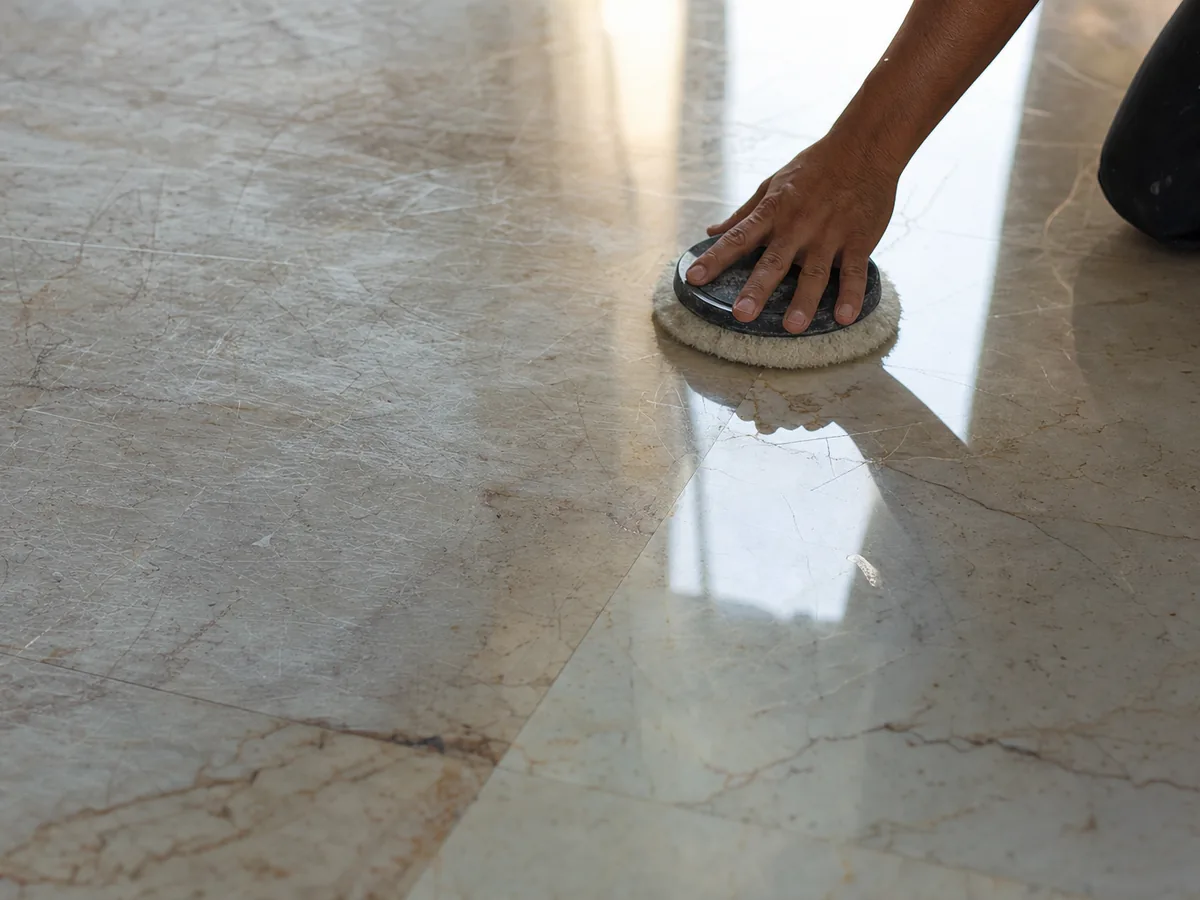
The professional process works on the stone, not on the dirt. It is taken down lightly with diamonds to remove the micro-scratches, the whole surface is evened out and it is finished with crystallisation, which brings back the shine and leaves a protective layer. The result is an even floor, without the difference between “worn areas” and “untouched areas”. To keep it that way, a maintenance buffing every so often is enough, as we explain in our guide on how often marble needs polishing. The surface finishing treatments of natural stone they are, precisely, the technical way to recover a worn pavement without replacing it.
How to prevent marble from getting scratched and worn again?
The best way to prevent marble from getting scratched is to keep away from grit and sandpaper. With simple care, a freshly polished floor will stay beautiful for much longer.
- Doormats at the entrances to retain sand and dust from the street.
- Felt under the legs of furniture, chairs and tables, and avoid dragging them.
- Carpets or protectors in the busiest areas.
- Clean only with neutral products, never acids or abrasives.
- A periodic seal that protects the pore from stains and chafing.
None of them are expensive or complicated, and together they make the difference between polishing every few years or every many years.
Professional polishing of striped marble in Mallorca
If your marble floor has noticeable scratches, dull areas, or has lost its shine over the years, we'll take a look and tell you the truth: what can be restored and how. At Projectes Sastre, we do professional marble polishing and established throughout Mallorca, with over 50 years of experience and free quotes. If you'd like figures, here they are how much it costs to polish a marble floor. Call us at 971 503 936 or write to us at info@projectessastre.com.
Frequently asked questions about scratched and worn marble
Why does a marble floor scratch so easily?
Because marble is a soft stone, with a hardness of 3 on the Mohs scale, while the grit we track in with our shoes is harder (around 7). This grit acts like sandpaper every time we walk on it, and over time it scratches the surface and dulls its shine. This isn't a defect in the floor; it's the nature of the material, which is why it's advisable to trap dust with doormats and clean without abrasives.
Is it possible to remove a scratch from marble at home without a machine?
Only if it's a very superficial scratch, one that barely snags your fingernail. In that case, a specific marble polishing compound applied with a microfiber cloth can soften it. If the scratch is clearly visible when you run your fingernail over it, it's a deep scratch and no home remedy will remove it: you'll need diamond polishing. And never use vinegar or lemon, because the acid will permanently damage the marble.
Does buffing marble remove deep scratches?
No. Polishing or crystallisation adds shine and protection, but it's a surface treatment: it doesn't eliminate scratches that are noticeable to the touch. Applying it to a scratched floor makes it shine, but the grooves are still there underneath. To truly remove deep scratches, you need to polish with a diamond, which removes a minimal layer of marble and evens out the surface. After polishing, crystallisation makes sense for the finishing touch.
How much does it cost to repair a scratched marble floor in Mallorca?
It depends on the condition and size, but in 2026 marble polishing in Mallorca will cost between €10 and €25 per square meter, plus finishing, according to budget websites such as Cronoshare. A floor with widespread scratching will be priced higher because it requires several passes with a diamond blade. The only way to determine this accurately is through a site visit: we'll assess the actual damage and provide a fixed price with no obligation. If the problem isn't the scratches but the discoloration, the diagnosis changes completely: How to restore yellowed marble.