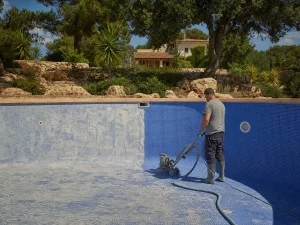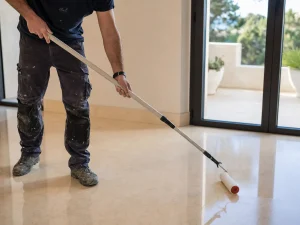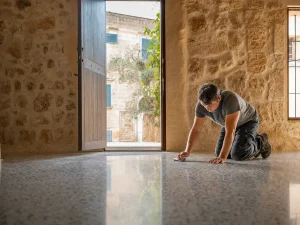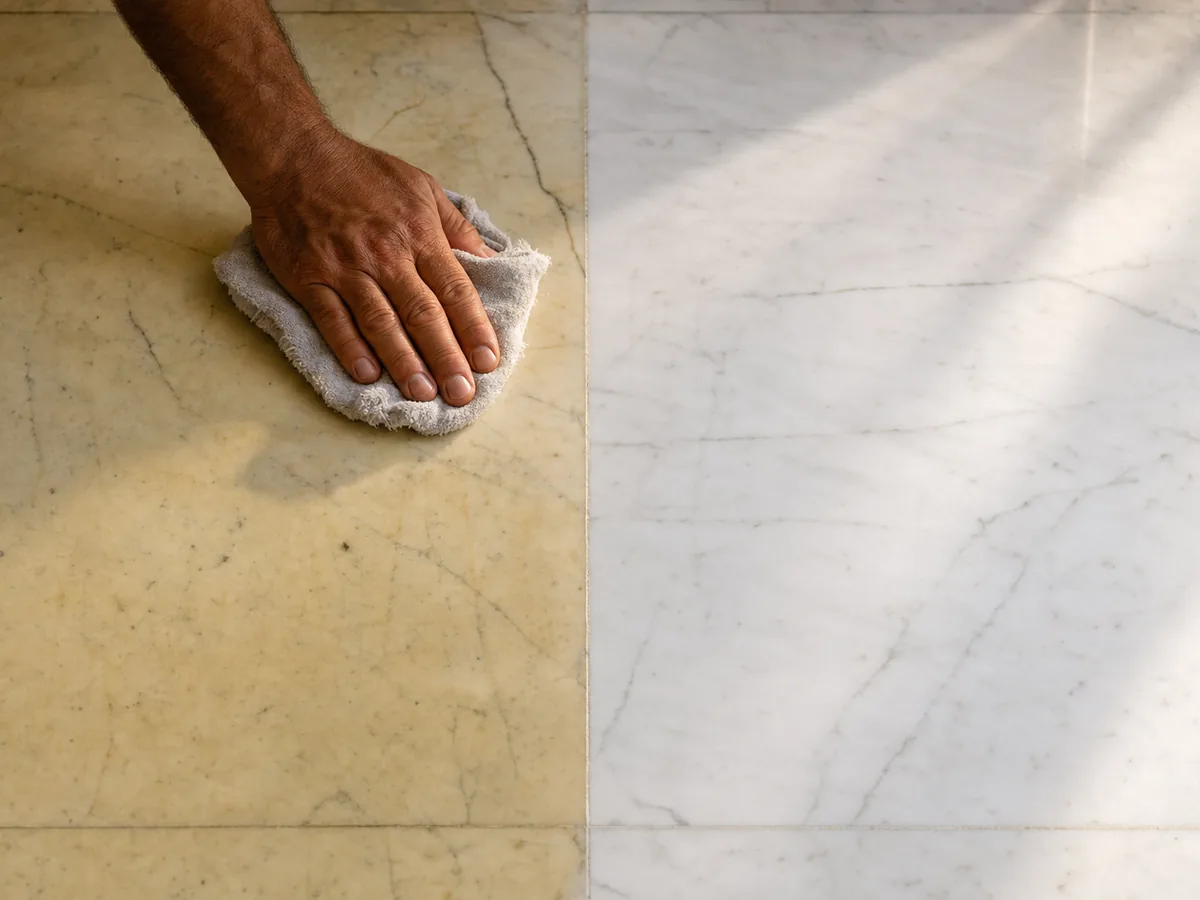
A marble floor yellows for four reasons: accumulated wax that has oxidized, iron oxide from the marble itself activated by moisture, residue from unsuitable cleaning products, and acid attack that has opened the pores and filled them with dirt. The first three can be resolved with stripping and deep cleaning; the fourth requires polishing. No household product will restore the whiteness to deeply yellowed marble, and bleach will only worsen the condition.
Dull marble and yellow marble are two different problems, and confusing them is the reason so many people get frustrated rubbing to no avail.
A dull marble floor has lost its shine: the colour is still there, it is just the reflection that is missing. A yellowed marble floor has changed colour, and no amount of buffing will bring it back. The first thing is to work out where that yellow is coming from, because each cause has its own solution and the wrong one usually makes things worse.
Why does a white marble floor turn yellow?
White marble yellows through build-up or through reaction, never because the stone "ages" by itself. These are the four real causes, in order of how often we see them in the homes we visit:
- Oxidized wax. Decades of waxing that has oxidized and trapped dirt. It's the number one cause by far.
- Iron oxide. Almost all marble contains traces of iron; with constant damp that iron oxidises inside the stone and stains it yellow or brown.
- Cleaning product residue. Detergents with dye, soaps that don't rinse well, and mop air fresheners that leave a film.
- Acid attack. Vinegar, lemon, limescale removers or hydrochloric acid have opened the pores; from then on, dirt enters and cannot come out.
There is a fifth, less common but very typical one in Mallorca: rising damp in ground floors and village houses, which carries salts and iron from the ground upwards and stains the floor in areas, always close to the walls.
How can you tell what's causing your marble to yellow?
It is identified with three simple tests that you can do in ten minutes, in a discreet area:
Test 1 — The nail. Scrape gently with a fingernail or a plastic scraper. If a yellowish film comes away and lighter marble shows underneath, it is built-up wax. Solution: stripping.
Test 2 — Water. Wet the area and wait a minute. If the yellow disappears or fades significantly when wet, the stain is on the surface and will come off with thorough cleaning. If the yellow remains the same even with the marble wet, the stain is embedded within the stone.
Test 3 — The map. Look at where the yellowing is. If it's uniform throughout the room, it points to wax or other product. If it follows the walls or forms irregular patches, it points to moisture and iron. If it coincides with walkways or where a rug used to be, it's buildup.
These three tests pinpoint the cause in the vast majority of cases. And knowing the cause prevents the most expensive mistake: polishing a floor that only needed a €200 stripping.
Can yellowing be removed from marble with homemade products?
Only if the cause is wax or surface dirt, and with plenty of limitations. A gentle strip with hot water and pH-neutral soap, working at it with a non-abrasive white pad, takes off part of the oxidised wax. Bicarbonate of soda made into a paste can help on isolated marks. None of that works if the yellow is inside the marble.
And there is a list of products that must never be used on marble, however often they turn up in forums:
- Bleach. It does not whiten marble and it can fix iron stains.
- Vinegar and lemon. They are acidic: they eat away at the surface and leave a permanent matte stain.
- Hydrochloric acid. It destroys marble immediately and irreversibly.
- Ammonia. It dries the stone out and leaves a haze.
- Metal scouring pad. It scratches and also leaves iron particles that later oxidize and yellow further.
This last point is worth insisting on: we have seen floors go yellow precisely because someone tried to clean them with steel wool. And never, under any circumstances, mix bleach and acidic products: the Ministry of Health warns repeatedly that this combination releases chlorine gas. The chemical agent safety data sheets published by the INSST set out the risks of these products in detail.
If you're looking for the right maintenance routine, we have it at how to clean a marble floor so that it shines.
How do you remove yellowing caused by oxidized wax?
It is removed with a professional strip in three stages: applying an alkaline stripper made for natural stone, mechanical removal with a rotary machine and a white pad, and a thorough rinse with a neutraliser. It does not need polishing or grinding material away, so it is the cheapest scenario of all.
A strip of this kind in an 80 m² home runs between €400 and €700, against the €1,000-€2,000 of a full polish. That is why it is so worth doing the tests first.
The result comes as a surprise: under forty years of wax there can be marble that is practically untouched. After that it is worth deciding on the finish, and that is where buffing a marble floor comes in, to give it back the shine the wax was imitating.
How do you remove an iron oxide stain from marble?
Iron stains are not cleaned: they are drawn out. The professional method is the poultice, which means applying an absorbent paste loaded with a reducing agent specific to iron, covering it with cling film and leaving it to work for 24 to 48 hours. As it dries, the paste pulls the rust out of the pore by capillary action. Sometimes it has to be repeated two or three times.
It is slow work and not always complete. If the iron comes from the stone itself and the damp is still active, the stain will come back: the water has to be cut off first.
Stone conservation studies of Eduardo Torroja Institute of Construction Sciences of the CSIC have been documenting these alteration mechanisms in stone materials for decades, and the conclusion is always the same: without removing the cause, the treatment is only cosmetic.
When should marble be polished to restore its color?
Polishing is needed when the yellow is inside the stone and will not come out with stripping or with a poultice, which is what happens when there has been an acid attack. The acid opens up the pore of the marble and the dirt settles into that new porosity; the only way to get the colour back is to grind the material down until you reach sound stone.
A polish removes between 1 and 4 millimetres, and under that layer the marble is usually perfect. It is the definitive solution, and in Mallorca it costs between €10 and €25/m². The trade-off is that the wearing layer is not infinite: marble cannot be polished indefinitely, so it is best not to reach this point more times than necessary.
When the floor also has cracks or damaged pieces, the work moves into the territory of floor restoration in Mallorca, which combines repair, polishing and final treatment.
How to prevent marble from yellowing again?
- Stop waxing. Wax is the number one cause of long-term yellowing.
- Scrub only with neutral soap with a pH between 7 and 8, and rinse.
- No vinegar, lemon, limescale removers or acidic disinfectants.
- Dry up water splashes within the hour in damp areas.
- Seal the marble with a specific water repellent every 3 to 5 years.
- Put a doormat at the entrance to stop sand and dirt.
- If there is rising damp, sort it out before treating the floor.
Point 5 offers the best results and is the least applied. Sealing closes the pores and prevents both dirt from entering and iron from migrating. We integrate it into the maintenance of marble floors in homes and residents' associations.
Frequently asked questions about yellowed marble floors
Why has my white marble floor turned yellow over the years?
In most cases it is built-up wax that has oxidised. For decades marble was waxed as a maintenance routine, and that wax ages, yellows and traps dirt, forming a film that hides the real stone. The second most frequent cause is the iron oxide present in the marble itself, which is triggered by constant damp and stains the stone from within.
Does bleach whiten a yellowed marble floor?
No, and it can make things worse. Bleach does not act on the pigment that yellows the marble, and on stains of iron origin it can fix the rust and make them harder to draw out afterwards. Nor is it harmless to the stone if it is left to work: it dries the surface out and leaves a haze. For yellowing caused by wax, the right product is an alkaline stripper made for natural stone.
How much does it cost to restore a yellowed marble floor in Mallorca?
It depends on the cause. Stripping oxidised wax in an 80 m² home costs between €400 and €700. Drawing out iron stains with a poultice is quoted by treated area, normally between €80 and €250 a stain depending on size. If a full polish is needed because the yellow is inside the stone, the price sits between €10 and €25/m², that is, between €800 and €2,000 for those 80 m².
Can marble that has yellowed from damp be brought back without fixing the damp?
It can be cleaned, but it will come back. As long as water keeps coming in from the ground or from a leak, it will keep carrying salts and iron to the surface of the marble and the stain will reappear within months. The right order is to find and stop the damp getting in, let the substrate dry and only then treat the floor. Doing it the other way round means paying twice.
Does all marble yellow or does it depend on the type?
It depends a good deal on the type. White marbles with grey veining, such as Carrara or Macael, show the yellowing far more clearly than cream tones like Crema Marfil, where the change of colour goes almost unnoticed. The iron content of the mineral also plays a part: marbles with more traces of iron are more prone to brown stains where there is damp.
What NEVER to do with yellowed marble
- Do not use bleach or chlorinated products. They do not whiten and can set rust.
- Do not use acids of any kind. The damage to marble is immediate and irreversible.
- Do not scrub with a metal scouring pad. It scratches and leaves iron behind that yellows further later on.
- Do not wax over it to hide it. You'll be adding another layer to what is already a problem.
- Do not polish before you have ruled out stripping. Polishing uses up thickness, and thickness does not come back.
Do you want to know why yours has yellowed?
We will come and look, run the tests on the spot and tell you whether yours is a €500 strip, a stain extraction or a full polish. Free and with no obligation, anywhere in Mallorca. Call us on 971 503 936 or write to info@projectessastre.com from the contact page. As floor restoration experts in Mallorca with over 50 years of experience, the first thing we're going to try is the cheapest solution that works.