A well-maintained floor makes all the difference. It may seem like a minor detail, but when the floor is shiny, even, and clean, it enhances the entire space. It's something you instantly notice, whether in your home, a commercial space, or an office. The downside is that, with daily use, that good impression fades: scratches, stains, dull areas... everything accumulates. And that's when it's time to consider polishing your floor.
In this guide, we explain how to do it yourself—if you're up for it—what tools you'll need, how the process adapts to different materials, and when it's more practical to call in professionals.
And if you're in Mallorca and want to forget about complications, you can trust our floor polishing service in Mallorca, with customized solutions for every type of surface.
Is it really worth polishing the floor?
Yes, and not just for aesthetic reasons. In fact, there are several reasons why many people do it even before the floor looks bad.
A good polish not only restores shine: it also removes marks that don't come off with normal cleaning, smooths out small imperfections, and, above all, protects. By reducing porosity, the floor accumulates less dirt, withstands wear and tear better, and becomes easier to maintain. All of this extends its lifespan, which is no small feat.
There's something else not everyone understands: polishing is not the same as vitrifying (or buffing). They are two different steps:
- Polishing acts on the material itself, “renewing” it by removing damaged layers.
- Buffing or vitrification, on the other hand, is a finish that is applied afterwards and serves to provide shine, yes, but also extra protection.
Sometimes one is enough, other times both are used. It depends on the floor, its condition, and the intended use.
Necessary tools and materials
There's no mystery here, but it's a good idea to prepare well before starting. The basics are:
- A polishing machine. It can be a single-disc or a professional type.
- Diamond discs with different grain sizes: coarse, medium and fine.
- Polisher or crystalliser, depending on the type of floor.
- Industrial vacuum cleaner or mop to clean up afterward.
- Gloves, goggles, and a mask. They're not the most comfortable, but they're important.
And one detail worth keeping in mind: handling a polisher isn't as simple as it seems. It's not like sweeping. It takes some practice to get the job done right and, above all, to avoid damaging the floor. If you've never used one before, you might want to try it on a hidden area... or consider calling someone with experience.
The process, step by step (but without complicating your life)
Every floor has its own things, but the general process, so to speak, usually follows this order:
1. Deep cleaning
Before touching the machine, it's time to clean it thoroughly. It's no good sweeping over it. Remove everything: dust, grease, stains... because anything left behind can interfere with the polishing process. And the cleaner it is, the better it will look later.
2. Prepare the machine
The first thing to do is to attach the appropriate disc, usually the coarsest grit. This will remove the most damaged top layer. Make sure it's securely fastened and that the machine is ready.
3. Polish in stages
There are no shortcuts here. Start with the coarse disc, then move to the medium disc, and finish with the fine disc. This smooths the floor until it's as smooth as possible. Do this slowly, without rushing, keeping the machine steady and moving forward slowly.
4. Apply the polish
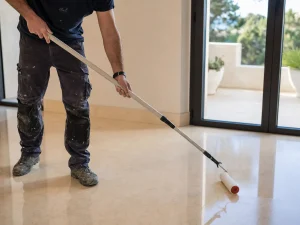
Once the floor is polished, it can be given that shiny finish many seek. To do this, apply specific products, either polishing or crystallising, with steel wool or a special pad. Each material has its tricks, so it's important to use the right product.
5. Maintenance after polishing
Once everything's done, it's worth taking care of it a bit. It's not a question of obsessing, but rather avoiding mistakes:
- No aggressive or abrasive products.
- It is better to use neutral cleaners.
- And repeat the process from time to time, depending on how much the floor can handle on a daily basis.
Depending on the type of floor, the approach changes
Not all floors are treated the same. Some polish almost effortlessly, while others require more care. Here's the basics of each:
Polishing the marble floor
Elegant, yes, but delicate. It requires working with fine discs and specific products. If done incorrectly, the shine can be lost forever. It's best not to improvise with this type of material.
Polishing terrazzo
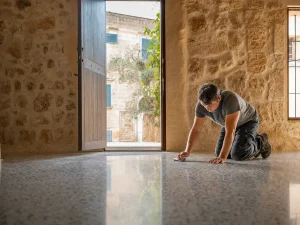
More durable than marble, but it also fades over time. It can be polished with diamond discs, and for a long-lasting finish, a crystalliser is recommended.
Polishing parquet or wooden floors
Here everything changes. Instead of a polisher, a sander is used. Also, no water: wood doesn't tolerate it well. After sanding, varnish or protective oils are applied. If you're inexperienced, the sanding process can end up uneven or with poorly finished areas.
Polishing the cement floor
Very common in commercial buildings, garages, or industrial spaces. Polishing requires several passes, and is often finished with a sealer to protect the surface. It's a rewarding material if done well.
Is it worth doing it yourself or is it better to call a professional?
It's a fairly common question, and the answer depends on your time, budget, and desire.
If you do it on your own
- Advantages: You save on labor and you can learn something useful.
- Disadvantages: Renting the machine isn't cheap, and if you don't do it right, you can leave marks that are hard to fix.
If you hire a professional
- Advantages: more uniform finishes, proper tools, less worries.
- Disadvantages: higher initial cost, although in the long term it may be better if you avoid repeating the work or correcting errors.
At Projectes Sastre, we offer a floor polishing service in Mallorca designed for those who want a long-lasting result, done right from the start and tailored to your floor type.
Questions that often arise
How often should a floor be polished?
It depends. In homes, it's usually done every 3 to 5 years. In commercial or busy spaces, it might be every 1 or 2 years.
Can I do it without a machine?
Only if it's a very small area. It can be done by hand, with sandpaper and special products, but the result won't be the same. For a large surface, it's not worth it.
What is the price?
It varies depending on the square footage and the type of flooring. As a guide, it can be around €10/m². It's best to request a quote tailored to your situation.
Are polishing and buffing the same thing?
No. Polishing involves renewing the surface by removing imperfections. Buffing is done afterward and serves to protect and give that final shine.
A noticeable change
When a floor is well polished, the entire space improves. It doesn't just shine: it's easier to clean, lasts longer, and conveys a sense of order and care that, without saying anything, speaks volumes.
If you live in Mallorca and are thinking about renovating your floor, Projectes Sastre can help you. We have been offering renovation services for over two decades floor polishing in Mallorca, with results that speak for themselves. Request a no-obligation quote and we'll advise you at your own pace, according to your needs. And if you need to know the exact number of days the work will take, we'll provide a breakdown by meter and material how long it takes to polish a floor.