Sandblasting wooden beams is the cleanest way to restore their original grain and color: it projects an abrasive at controlled pressure that removes old paint, cracked varnish, soot, and stains without hand sanding or damaging the wood. In Mallorca, it's the preferred technique for restoring the ceilings of country houses, farmhouses, and hotels with antique beams. The cost ranges from €20 to €40 per linear meter, depending on the condition, height, and subsequent finish.
If you have wooden beams darkened by age and you're unsure whether to replace them or restore them, the answer is almost always to restore them Projectes Sastre we've been sandblasting across the island for over 50 years, and a beam that seems lost under layers of paint often hides perfectly sound wood. Here we explain how sandblasting works on wooden beams, what abrasive is used, how much it costs, and when it's worthwhile.
What is sandblasting of wooden beams?
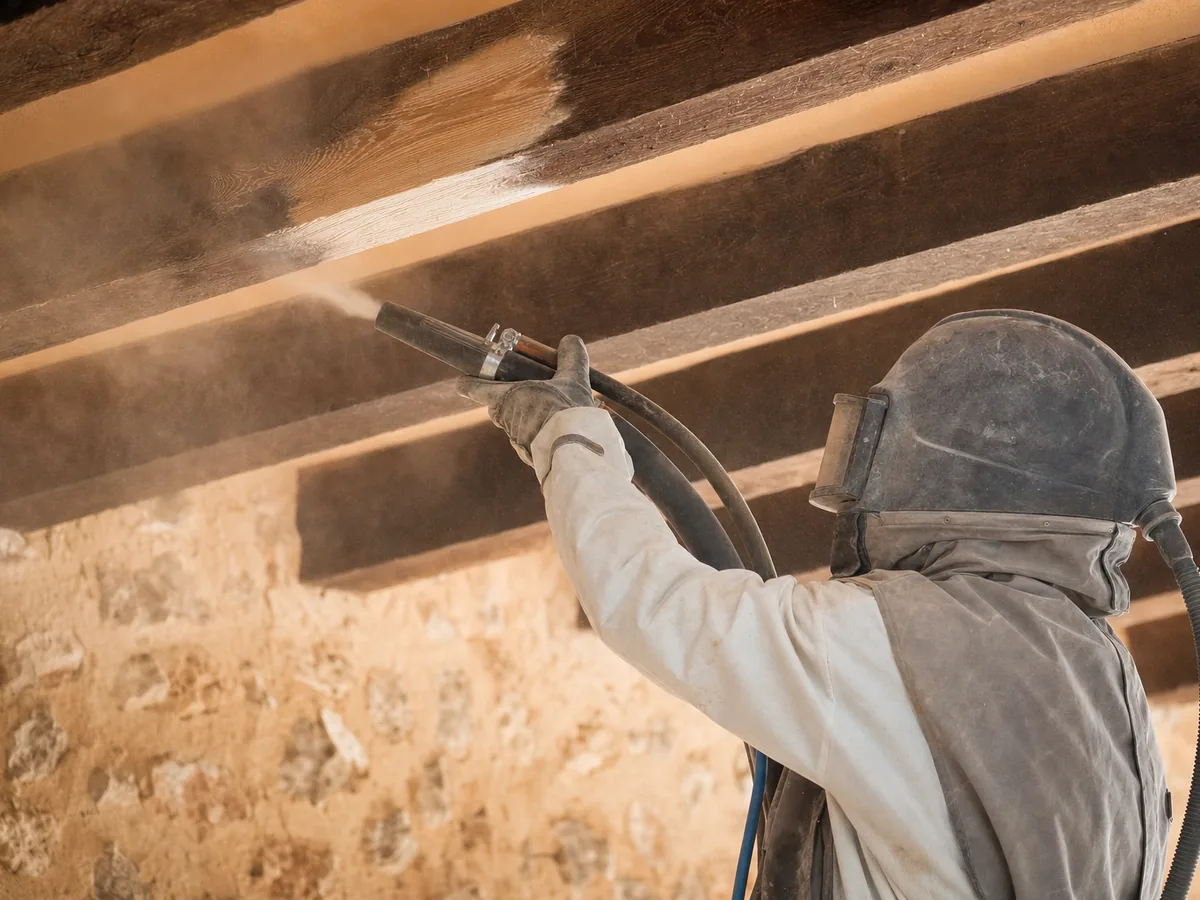
Sandblasting wooden beams is a cleaning and restoration process that involves projecting a fine abrasive under pressure onto the wood's surface to remove accumulated layers such as paint, old varnish, smoke residue, treatment remnants, and embedded dirt. It reveals the natural grain without damaging the structure.
It's not sanding. And it's not a chemical product. It's compressed air pushing an abrasive that "combs" the wood. The big difference compared to other methods is that it reaches every nook and cranny—corners, joints, the top surface of a beam attached to the ceiling—where a sander can't. That's why it's so widely used in sandblasting of elements with relief or difficult access.
In an old house in Mallorca, where the beams are usually varnished with dark products from decades ago or painted white in some renovation from the 80s, sandblasting returns them to their warm tone of real wood.
How are wooden beams restored by sandblasting, step by step?
The professional sandblasting process for wooden beams follows a clear order. It's not just about "throwing sand": pressure control and the choice of abrasive are what separate a good job from damaged wood.
- Beam inspection. The type of wood, its condition, and whether there is woodworm, moisture, or weakened areas are checked before touching anything.
- Environmental protection. Furniture, floors, and walls are covered, and the room is insulated. Sandblasting generates dust, so protective gear is part of the job.
- Abrasive selection and pressure. The grain and pressure are adjusted according to the hardness of the wood and what needs to be removed (paint, varnish, soot).
- Controlled pressure blasting. It is done in uniform passes, removing the surface layers without opening the fiber.
- Vacuuming and dusting. All residue is removed to leave the wood clean and dry.
- Treatment and final finish. Protection is applied: oil, wax or varnish, and anti-woodworm treatment if there is a risk of woodworm.
That last step is just as important as the sandblasting. A freshly sandblasted beam has open pores: protecting it is what fixes the result for years.
What advantages does sandblasting have over sanding or brushing beams?
The main advantage of sandblasting over sanding is that it preserves the shape and texture of old wood. An old beam isn't flat or even; it has axe marks, knots, and natural grain. Sanding removes these features, leaving a "new piece of furniture" surface that clashes with a house steeped in history. Sandblasting cleans without creating a uniform finish.
There are more reasons why sandblasting is preferred in restoration:
- It reaches everywhere. Corners, joints and the upper face of the beam, impossible to sand with a sander.
- It does not use solvents. No chemical paint strippers that soak into the wood and take a long time to evaporate.
- It's faster on large surfaces. An entire beamed ceiling can be done in a fraction of the time it takes to sand it manually.
- It brings out hidden flaws. By cleaning thoroughly, any woodworm or rot will appear and can be treated in time.
However, if done incorrectly, at too high a pressure, sandblasting can indeed damage soft fibers. That's why it's not a DIY job. The key is in choose the right abrasive for each material and in the hands of the one who handles it.
What abrasive is used for sandblasting wooden beams?
Not just any sand is used for sandblasting wood. Wood is a relatively soft material, so mild or medium-hardness abrasives with fine grit are used, never the aggressive ones reserved for metal. And importantly: silica sand is prohibited due to its health risks. According to the National Institute for Safety and Health at Work (INSST), respirable crystalline silica is carcinogenic, so a professional always works with alternative abrasives.
| Abrasive | Hardness / grain | Recommended use on wood |
|---|---|---|
| Aluminum silicate (fine corundum) | Medium, low impact | General stripping of beams without damaging the fiber |
| Garnet mineral | Tall but reusable, little dust | Durable paint and varnish for hardwoods (oak) |
| Vegetable granules / peel | Very soft | Fragile woods and delicate finishes |
| Sodium bicarbonate | Very soft, water-soluble | Light cleaning, soot and surface dirt |
The choice depends on the type of wood and what's on top of it. An oak beam with plastic paint isn't treated the same as a pine beam with a thin varnish. You can see more about What is sandblasting used for? on each type of surface.
How much does it cost to sandblast wooden beams in Mallorca?
The price for sandblasting wooden beams is calculated per linear meter and usually ranges between €20 and €40 per meter, to which an additional €10-12 per meter is added if subsequent treatment and varnishing are included. The official reference for construction costs of CYPE it includes specific items of abrasive blasting on beams, which confirm that order of magnitude.
Why does it vary so much? It depends on several factors:
- The starting state. A beam with several layers of old paint requires more work than one that is only dirty.
- The height and the access. Working on a high roof or with scaffolding increases the cost of the project.
- The number of meters. A complete roof has a better price per meter than a few loose beams.
- The finish. Leaving it in clean, exposed wood doesn't cost the same as sandblasting, treating against woodworm, and varnishing.
In a Mallorcan house with a medium-sized beamed ceiling, the best way to know the real cost is a visit: we measure, see the condition and give a fixed budget without surprises.
When is it advisable to sandblast the beams of a farm or country house in Mallorca?
Sandblasting beams is advisable when the wood is sound but its appearance is deteriorated: darkened by chimney smoke, with cracked varnish, painted over in a previous renovation, or simply dulled by age. In these cases, sandblasting restores the beam's original appearance and avoids the expense—and the loss of character—of replacing it.
In Mallorca, this is very common. The country estates and farmhouses in the interior, the restored farmhouses, and many charming hotels retain exposed wooden beams, which are part of their charm. The Mediterranean climate, with its humidity and salt air near the coast, takes its toll on the wood over time, and a thorough restoration can extend its lifespan by decades.
However, it's not advisable when the beam has actual structural damage—advanced rot or woodworm that has compromised its strength. In those cases, the structure must first be assessed and, if necessary, reinforced or replaced. Sandblasting is for recovering good wood, not for covering up a safety issue.
Quote for sandblasting your wooden beams in Mallorca
If you have wooden beams that have lost their appearance and you want to know if they can be restored, we can tell you clearly. At Projectes Sastre, we sandblast wooden beams and ceilings throughout Mallorca, with over 50 years of experience and free, no-obligation quotes. Call us at 971 503 936 or write to us at info@projectessastre.com and we arranged a visit to see your beams.
Frequently asked questions about sandblasting wooden beams
Does sandblasting damage old wooden beams?
Done well, no. At controlled pressure and with the appropriate abrasive, sandblasting removes surface layers without opening the grain or weakening the beam. The risk arises when too much pressure or an aggressive abrasive is used, which is why it's not a DIY job. A professional adjusts the grit and pressure to the type of wood before starting.
What treatment is applied to wooden beams after sandblasting?
After sandblasting, the wood's pores are open and need protection. Typically, an oil, wax, or varnish is applied to fix the color and protect it from moisture, along with an anti-woodworm treatment if there's a risk of infestation. This finish is what keeps the beam beautiful and protected for years; without it, the wood will quickly become dirty again.
Can the beams be sandblasted without dismantling them or emptying the house?
Yes. Beam sandblasting is done on-site, without removing the wood from the ceiling. We do, however, isolate and protect the room well, because the process generates dust. We cover furniture, floors, and access points, and when finished, everything is vacuumed and cleaned. In occupied homes, the work is carried out in phases to minimize disruption.
How long does it take to sandblast the beams of a house?
It depends on the size and condition of the ceiling, but a beamed ceiling in an average-sized room can usually be sandblasted in one or two days, plus the time for subsequent treatment. In a whole house with several rooms, the work is planned in sections. During the initial consultation, we provide a specific timeframe based on the actual work involved.