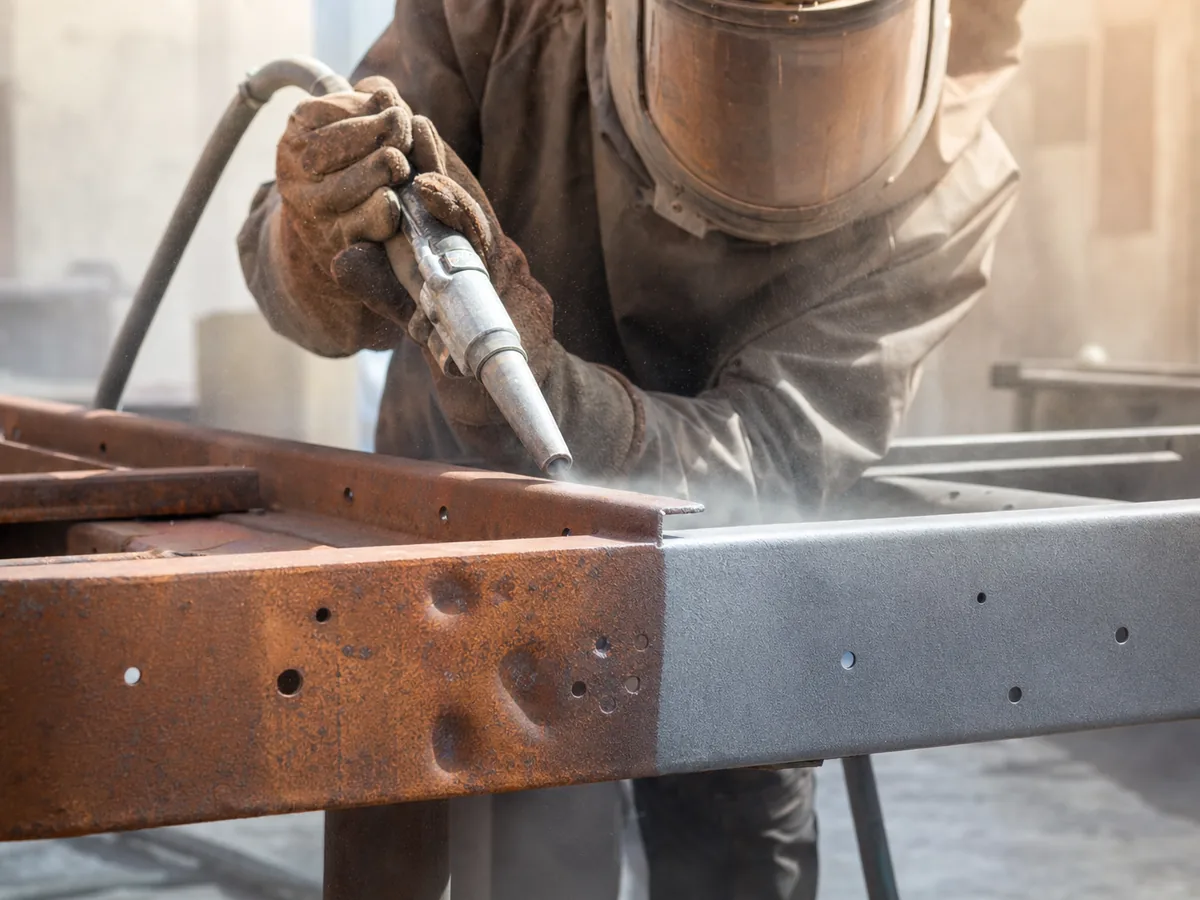
Removing rust from metal with sandblasting involves projecting a pressurized abrasive onto the piece to remove rust, scale, and old paint, leaving it clean and with a rough texture ready for painting. It is the fastest and most effective method for preparing railings, structures, machinery, or nautical parts before applying an anti-corrosion treatment. The finish is measured according to technical standards (Sa 2.5 grade of ISO 8501-1, "near-white metal," is the usual standard before priming). In Mallorca, metal sandblasting costs around €20-25 per square meter, depending on the condition of the piece.
When rust can no longer be removed with a wire brush and the paint is peeling off in patches, sanding by hand is a waste of time. Sandblasting solves in one pass what would take hours by hand, and the result is never quite as good Projectes Sastre we've been sandblasting all types of surfaces across the island for over 50 years. We'll explain how it removes rust, the finish it leaves, which surfaces it's suitable for, and the cost.
What is metal sandblasting and how does it remove rust?
Metal sandblasting is a cleaning process that uses abrasive projection: a machine propels a hard material (shot, corundum, garnet) against the metal surface at high speed using compressed air. This continuous impact removes rust, mill scale, and layers of old paint, leaving the bare metal exposed.
It works by mechanical abrasion, not chemical. There are no paint strippers or acids soaking the piece. The abrasive strikes, the rust flakes off, and in the process, leaves a uniform micro-roughness on the metal that will later be key for the paint to adhere. It's the same principle as sandblasting applied to metal surfaces, where the finishing requirements are higher than on stone or wood.
The result: a clean, residue-free metal, ready to be primed the same day.
Why is sandblasting the most effective method for removing rust and old paint from metal?
Sandblasting is more effective than sanding, brushing, or using chemical strippers because it cleans thoroughly, reaches the entire surface, and prepares the metal in a single step. A wire brush removes surface grime but leaves rust in the pores; a stripper softens the paint but doesn't eliminate rust. Sandblasting does both at once and uniformly.
The specific advantages compared to other methods:
- Eliminate rust at its root, not only the outer layer, but also in corners, threads, and welds.
- Remove several layers of old paint in one pass, without softening them with solvent.
- Leave the anchor profile that the paint needs to last (we see it now).
- It is homogeneousThe entire piece is left with the same degree of cleanliness, something impossible by hand.
The type of abrasive changes the result, so it's advisable choose the right abrasive for each piece: steel shot for strong oxide and rough finish, corundum for precision, glass microsphere when scratching is not desired.
What is the metal sandblasting process step by step?
The professional sandblasting of a metal part follows an ordered sequence that ensures the surface is truly ready for painting, not just "cleaner".
- Inspection of the part. The material, the initial level of rust, and the desired finish are all taken into account.
- Protection and preparation. The work area is isolated and anything that should not be exposed to abrasives is protected.
- Abrasive selection and pressure. Depending on the piece and the desired level of cleanliness.
- Pressure blasting. The abrasive is projected in passes until rust, scale and paint are removed.
- Vacuuming and blowing. All dust and abrasive residue is removed from the surface.
- Anti-corrosion primer. The first layer of protection is applied as soon as possible, before the metal rusts again.
That last step is a race against time: freshly sandblasted metal starts to rust again in a few hours if the humidity is high, so the priming can't be left for another day.
What levels of surface preparation can be achieved with sandblasting?
The quality of sandblasting is not subjective: it is measured according to the international standard ISO 8501-1, which defines cleaning grades based on the amount of rust and scale removed. These grades are explained in detail in technical references such as Ingemecánica, they are the language with which a professional and a client understand each other about the finish.
| ISO 8501-1 Grade | Finish | Recommended use |
|---|---|---|
| Sa 1 | Light sandblasting: removes loose particles | Basic low-commitment preparations |
| Sa 2 | Commercial sandblasting: grayish surface | Structures in a non-aggressive environment |
| Sa 2½ | Near-white metal: only faint traces | The standard before priming most parts |
| Sa 3 | White metal: total cleaning | Highly corrosive environments (marine, industrial) |
In practice, the Sa 2½ This is the rating required for almost everything. For pieces exposed to the sea or very harsh environments, it's increased to Sa 3. Defining the rating in advance avoids misunderstandings and ensures that subsequent protection will hold.
Why does sandblasting prepare the metal for painting and anti-corrosion treatment?
Sandblasting prepares metal for painting because, in addition to cleaning it, it leaves a micro-roughness called an anchor profile: a texture of peaks and valleys (on the order of 50-100 microns) to which the paint mechanically adheres. On smooth or rusted metal, any coating will eventually peel; on sandblasted metal, it lasts for years.
That is the real reason why sandblasting is the essential preliminary step in any serious anti-corrosion work. Sandblasting isn't done "to make it look pretty": it's done so that the subsequent protective coating adheres and lasts. The official cost reference for CYPE for surface cleaning of metal profiles this operation is specifically included as a preliminary step to priming in steel structures.
Without proper sandblasting, even the best paint in the world will fail within a couple of seasons. With it, the same system withstands the humidity and salt air of Mallorca for much longer.
In which parts and sectors is metal sandblasting applied in Mallorca?
Metal sandblasting is applied to any metal part or structure that needs rust removal or repainting, for both individuals and businesses. On an island like Mallorca, with its proximity to the sea, rust is a constant problem, and sandblasting has applications in various sectors:
- Ironwork and blacksmithing: fences, railings, gates, wrought iron furniture, metalwork structures.
- Nautical sector: hardware, masts, hulls and boat parts, where saltpeter accelerates corrosion.
- Hotels and communities: outdoor furniture, metal stairs, pergolas, pool structures.
- Industry and machinery: Parts, tanks, profiles and structures that need to be prepared before painting.
In the nautical field, we also have specific experience in sandblasting of boats, where the finishing and care of the piece are especially delicate.
How much does sandblasting metal cost in Mallorca?
The price of metal sandblasting in Mallorca is around €20-25 per square meter, within a general range for sandblasting that goes from €5 to €35 per square meter depending on the work. The final price depends on several specific factors:
- The condition of the piece: More rust and more layers of paint, more work.
- The required level of finish: Reaching Sa 3 takes longer than reaching Sa 2.
- Size and shape: A flat surface is more efficient than a structure full of nooks and crannies.
- Working at heights or in a workshop: Transportable parts are sandblasted in the workshop; fixed structures, on site.
Since each piece is unique, it's best to see it in person. We'll measure it, assess its condition, and provide a fixed price quote. You can see more examples here What is sandblasting used for? and what results it gives in each case.
Metal sandblasting quote in Mallorca
Do you have railings, structures, or metal parts eaten away by rust? Before replacing them, let us take a look. At Projectes Sastre, we offer metal sandblasting services throughout Mallorca, leaving the surface ready for painting. With over 50 years of experience and free estimates. Call us at 971 503 936 or write to info@projectessastre.com and we value it.
Frequently asked questions about metal sandblasting
Does sandblasting completely remove rust from metal?
Yes. Unlike a brush or sandpaper, which only affect the surface, sandblasting removes rust from inside pores, threads, and welds, leaving the metal bare. The degree of cleanliness is defined beforehand (for example, Sa 2.5 or Sa 3 according to ISO 8501-1), so you know exactly how the part will look before you start.
Why is silica sand prohibited for sandblasting?
Silica sand is banned as an abrasive because, when struck, it releases respirable crystalline silica particles, a carcinogen that causes silicosis. According to the National Institute for Safety and Health at Work (INSST), it is a serious occupational hazard, which is why professionals work with alternative abrasives (shot, corundum, garnet) and with appropriate protective equipment.
What is the difference between dry sandblasting and wet sandblasting?
Dry sandblasting projects only abrasive and is the fastest and most aggressive method, ideal for removing heavy rust, but it generates a lot of dust. Wet sandblasting (or hydroblasting) mixes water with the abrasive, produces much less dust, and is more suitable for delicate parts or jobs where dust is a concern. The choice depends on the part, the environment, and the desired finish.
How long does the protection last after sandblasting and painting the metal?
It depends on the paint system and the exposure, but a properly sandblasted (with its anchoring profile) and correctly primed metal can last for many years without rusting again, even near the sea. The key is precisely in the sandblasting: it's what gives the paint adhesion. Without this preparation, any coating will peel off in one or two seasons, no matter how good the paint is.