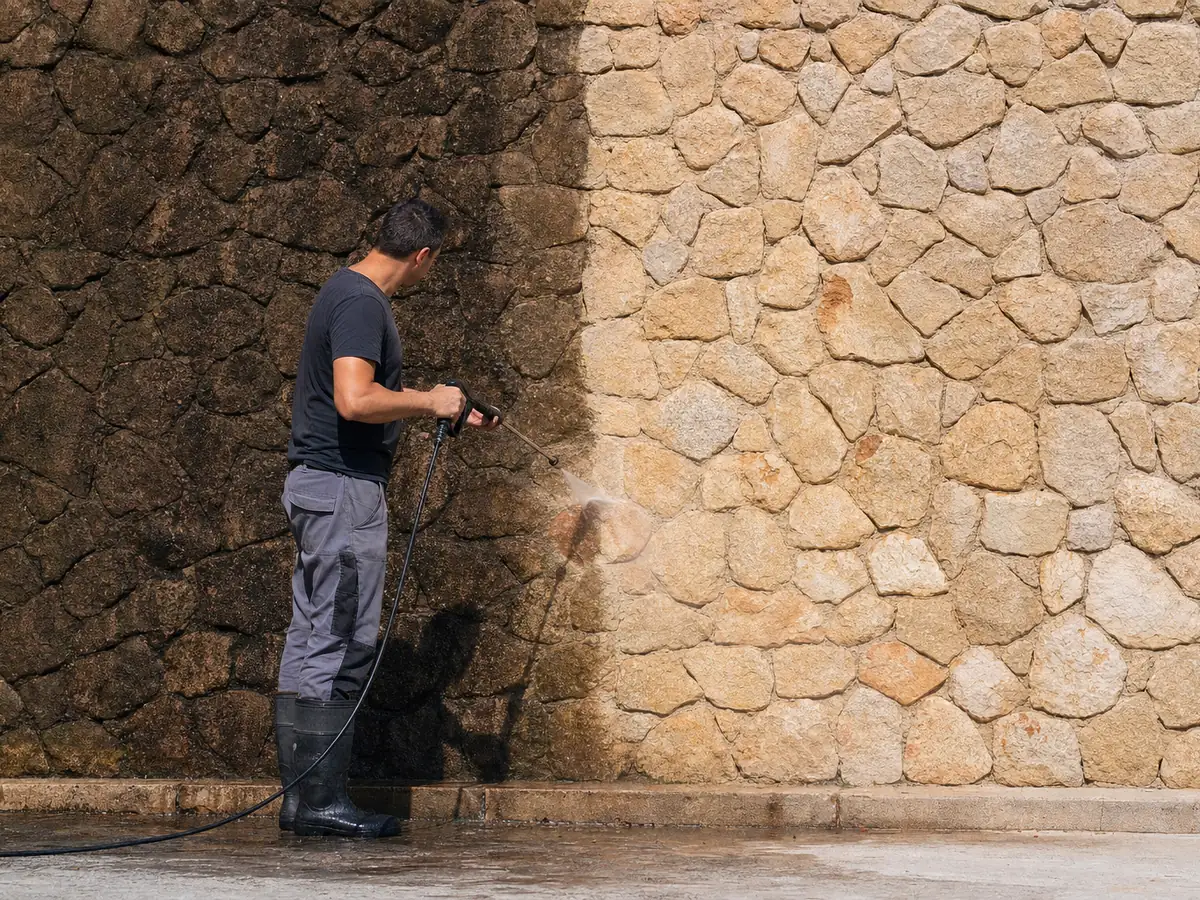
Pressurized water cleans what's on the surface; sandblasting removes what's stuck on. For environmental dirt, moss, and pollution, pressure washing is sufficient, costing between €4 and €12/m². For paint, rust, graffiti, or black crust, sandblasting is necessary, costing between €8 and €30/m². On soft stone like marés, the correct solution is usually hydro-sandblasting: water and abrasive at the same time, with less damage than dry blasting.
"Isn't it cheaper with a pressure washer?" Yes. It almost always is cheaper.
The question is whether it will work, and that depends entirely on what you want to remove and what the surface is made of. Getting it wrong one way means spending money on a job that does not clean; getting it wrong the other way means doing irreversible damage to a facade that had been standing for two hundred years. Here is the criterion.
What is the difference between sandblasting and pressure washing?
The difference lies in the mechanism: pressurized water cleans by hydraulic impact and drag, while sandblasting cleans by mechanical abrasion, projecting solid particles that erode whatever is adhered to the surface. Water loosens; the abrasive scrapes.
| High-pressure cleaning | Sandblast | |
|---|---|---|
| What it removes | Dirt, dust, green algae, mould, pollution | Paint, rust, graffiti, black crust, varnish |
| How it works | Water pressure, 100-250 bar | Abrasion with projected particles |
| How aggressive on the substrate | Low or medium | Medium to very high |
| Waste it generates | Dirty water | Abrasive used + detached material |
| Indicative price | 4-12 €/m² | 8-30 €/m² |
| Risk of damage | Low, except under excessive pressure | High if the abrasive or the pressure are not the right ones |
| Typical use | Periodic maintenance | Restoration and paint stripping |
Put briefly: pressure washing is maintenance and sandblasting is surgery.
When is pressure washing advisable?
Pressure washing is appropriate when the surface contains deposited dirt, not chemically bonded dirt. Moss on a shady porch, dust and pollution on an urban facade, soil residue on a dry stone wall, or the annual maintenance of a tiled terrace are all examples of situations requiring pressure washing, period.
It is also the right choice when the substrate cannot withstand abrasion: highly degraded stone, coatings with a finish that you want to preserve, or delicate materials.
- Facades with environmental dirt less than 10 years old.
- Green algae, moss and mould in shaded, damp areas.
- Terraces, porches and pavements on a maintenance basis.
- Dry stone walls and sound masonry walls.
- Preliminary cleaning before assessing if anything else is needed.
That last point is a professional tip: on questionable facades, we first wash them with water and then decide. Sometimes the problem disappears with washing, and sandblasting is no longer necessary.
When is sandblasting necessary?
Sandblasting is needed when what has to come off is stuck fast or embedded and water will not shift it. Paint of any kind, rust, varnish on wood, graffiti, black crust from sulphated pollution and mortar or cement residue all fall into this category.
- Paint stripping on facades, railings and metal structures.
- Rust on metalwork, railings and machinery.
- Wooden beams with varnish, paint or plaster remnants.
- Graffiti on stone, where water alone cannot reach.
- Black crust on historic facades in the town centre.
- Metal surface preparation before painting.
In these cases pressurised water is not a cheaper alternative: it is money thrown away, because it does not do the job. If your case is graffiti, we deal with it separately in how to remove graffiti from stone or facades.
What is hydro-sandblasting and why is it often the answer in Mallorca?
Hydroblasting combines both methods: it projects abrasive mixed with water, so the water cushions the impact of the particles and washes away the residue. It cleans almost as well as dry blasting but with considerably less damage to the surface, and without the dust cloud.
On the island, this matters a great deal for one specific reason: the marés stone. Mallorcan sandstone is soft and porous, and a poorly calibrated dry blasting process removes its surface crust—the most compact layer, which protects against moisture and salt—leaving it permanently exposed. Hydroblasting significantly reduces this risk.
The trade-off is that it generates water with residue that has to be collected and disposed of, and that it cannot be used indoors or on materials that will not take moisture, such as a wooden beam that is to be varnished straight afterwards. We break down how to choose the right abrasive for each case in which abrasive to choose for each sandblasting job.
Which method is best suited to each material?
| Material | Pressurized water | Dry sandblasting | Hydro-sandblasting |
|---|---|---|---|
| Marés and sandstone | Yes, low pressure | Only with very mild abrasive | Recommended |
| Santanyí stone | Yes | With caution | Recommended |
| Exposed brick | Yes | Yes, medium pressure | Yes |
| Concrete | Yes | Yes | Yes |
| Wood (beams) | No, it swells it | Recommended, mild abrasive | No |
| Iron and steel | Insufficient | Recommended | Yes, if it is primed quickly |
| Stainless steel | Yes | Glass microsphere only | Yes |
| One-coat render | Yes, low pressure | No, it rips it off | No |
| Crumbling stone | No | Never | No |
That last row is the most important in the table. A stone that is already losing material isn't cleaned: it's consolidated. Applying pressure or abrasion will only ruin it. This is one of the cases we reviewed in the surfaces where sandblasting should not be used.
Which of the two methods costs more?
Sandblasting costs two to three times more than pressure washing. Pressure washing ranges from €4 to €12/m², sandblasting from €8 to €30/m², and hydroblasting from €12 to €28/m².
The difference isn't just in the labor. Abrasive is an expensive, non-reusable consumable in most jobs, and since the Royal Decree 1154/2020 classified exposure to respirable crystalline silica as exposure to a carcinogenic agent, cheap silica sand is out of the game. Today the work is done with aluminium silicate, corundum, steel grit or garnet, which cost several times more. The INSST documents sandblasting as one of the activities with the highest exposure precisely for this reason.
Added to this is the waste management: the used abrasive, mixed with paint or rust, is a waste product that must be bagged and delivered to an authorized waste management company according to the applicable waste regulations Conselleria de Medi Ambient of the Govern de les Illes Balears. Dirty water from a pressure washing, in most cases, does not pose that problem.
The full price breakdown is in our guide to sandblasting prices in Mallorca.
What are the risks of choosing the wrong method?
Choosing water when an abrasive is needed is an expensive but reversible mistake: you pay for a job that doesn't clean and then pay for the good one. Choosing an abrasive when water is needed is an irreversible mistake.
The damage we see most often from unsuitable blasting is this:
- Marés with the surface crust torn off, which from then on absorbs moisture and disintegrates.
- Exposed brick with the vitrified face removed, which is beginning to peel away.
- Empty mortar joints, with water entering the masonry.
- Wood with raised grain, which no longer accepts a smooth varnish.
- One-coat render and rendering lost completely.
None of the five have a cheap fix. That's why, when in doubt, you always start with the least aggressive solution and escalate only if necessary. There are more nuances to this in sandblasting damages surfaces: truths and myths.
Frequently asked questions about sandblasting and pressure washing
Can a marés stone facade be cleaned with pressurized water?
Yes, as long as it is done at low pressure and with an open nozzle, and as long as what has to come off is environmental dirt, green algae or dust. What you cannot do is put high pressure on marés: the stone is soft and porous, and water at high pressure opens up the pore and carries material away. For paint or black crust on marés, the right method is hydro-blasting with a mild abrasive.
What is the best method for removing paint from a facade?
To remove paint from a facade, the most effective method is sandblasting, because the paint is chemically bonded to the substrate and pressurized water won't lift it unless it's already peeling. The real choice isn't between water and abrasive, but rather which abrasive and what pressure, and that depends on the facade material. For soft stone, hydroblasting with a fine abrasive is the preferred method.
Does sandblasting consume water like pressure washing?
Dry sandblasting uses no water at all: it projects abrasive with compressed air. Hydroblasting does use water, although in much smaller quantities than a pressure washer, because the water only acts as a buffer for the abrasive. In jobs where access to water is difficult, such as isolated plots or facades without a nearby water source, dry sandblasting has a clear logistical advantage.
Which of the two methods is noisier and bothers the neighbours more?
Sandblasting is considerably noisier, because the compressor runs continuously and at high power, whereas a professional pressure washer makes less noise and does so more intermittently. Sandblasting also throws up dust or debris, which means protecting windows, cars and walkways. In residential blocks and town centres it usually needs prior notice and a council permit.
Can I rent a pressure washer and do it myself?
For a terrace, porch, or garden tiles, yes, it's a reasonable DIY job using a rental machine. For a facade, no: the risk of damaging joints, plaster, or stonework by using inappropriate pressure is high, and working at height requires auxiliary equipment and safety gear. Sandblasting, in particular, is not a job to undertake without training and protective equipment.
When NOT to use either method
- Crumbling stone or stone that is coming away. It needs consolidating, not cleaning.
- When the real problem is damp. Cleaning a facade with rising damp leaves it clean and wet.
- Facades with continuous cladding in poor condition. It comes off; it has to be made good and repainted.
- Listed elements without a prior report. In historic centres, authorisation may be required.
Not sure which one you need? Let's take a look
Send us a photo or tell us the location, and we'll tell you frankly whether your problem requires pressure washing, sandblasting, or hydroblasting, along with the price for each option. Sometimes the cheapest solution is the best, and we'll tell you that too. Call us at 971 503 936 or write to info@projectessastre.com. We are sandblasting specialists in Mallorca for over 50 years, and you can see everything covered by our sandblast cleaning service in Mallorca.