If you've ever wondered, "How can I polish my house's floors?", you've probably noticed that your flooring has lost its shine, has small scratches, or no longer has the uniform appearance it once did. Even if the floor is clean, daily wear and tear, foot traffic, and the continued use of certain products can gradually dull its finish.
At that point, polishing your home's floor ceases to be a merely aesthetic idea and becomes a practical solution to restore uniformity, feel and appearance without needing to replace the flooring.
Polishing your home's floor is not about applying a product to make it shine more, but about working the surface in a controlled way to restore it to its original state or improve its current condition.
If you're looking to polish your home's floors, it's helpful to clarify some concepts.
Before we get into how to polish my house's floors, it's important to understand what this process actually involves. Polishing is a technical treatment that works directly on the surface layer of the material through progressive abrasion. Its purpose is to remove micro-imperfections, fine scratches, accumulated product residue, and dull areas.
Polishing your home's floors is not the same as buffing or waxing. While buffing provides a temporary, superficial shine, polishing works the material itself to achieve a more uniform and lasting finish. Furthermore, not all floors are polished the same way or can be treated in the same way.
Should I polish my house's floors? First, identify what type of flooring you have.
One of the most common mistakes when considering polishing a home floor is not taking into account the type of flooring material. Each floor reacts differently and requires specific techniques.
Polish the floor of your house if it is made of marble or natural stone
Polishing marble floors at home can restore a bright and uniform finish, provided the right pads and grit levels are used. Marble, being a natural stone, loses its shine easily if acidic or abrasive products are used, but it responds very well to professional polishing.
The same applies to other natural stones such as granite or travertine, although each requires specific treatment. In these cases, polishing the floor also helps to close the pores of the material and facilitate its subsequent maintenance.
Polish the floor of my house if it's terrazzo
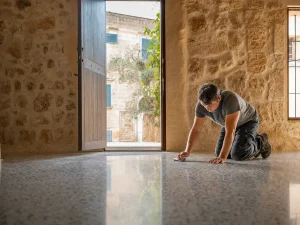
Terrazzo is one of the most rewarding floors for polishing. Over time, it tends to look dull, with signs of wear and matte areas. Polishing your terrazzo floor removes worn layers and restores its original appearance.
In many homes, polishing the terrazzo floor represents a noticeable improvement without the need for construction work or structural changes.
Polishing the floor of my house if it is porcelain or ceramic
Here, it's important to be especially careful. If you're wondering how to polish your house's floor and it's porcelain tile, you should know that not all porcelain tiles can be polished using traditional methods.
Polished or glazed porcelain tiles can have their appearance enhanced with specific treatments, but matte or non-slip porcelain tiles should not be polished as if they were natural stone, as they could lose their technical properties.
Polish the floor of my house if it is made of concrete
Polishing concrete floors is becoming increasingly common in modern homes. Polished concrete offers a seamless, durable, and easy-to-maintain finish, although it requires a more complex technical process and professional machinery to achieve a uniform result.
Polish the floor of your house if it is made of wood or parquet
Polishing wooden floors at home is not the same as polishing stone. Here, the treatment focuses on restoring the surface finish, whether varnish or oil, using appropriate products and pads. Abrasive discs, like those used on marble or terrazzo, are not used because they could damage the wood.
How to polish my house floor step by step
Once the type of flooring has been identified, the process for polishing the house floor must follow a series of well-defined phases to avoid mistakes and achieve a uniform finish.
Pavement preparation
Before polishing your home's floors, it's essential to properly prepare the surface. This includes removing furniture, vacuuming or sweeping thoroughly, and deep cleaning with appropriate products. If there are traces of wax or old products, stripping will be necessary beforehand.
Many problems when polishing your home's floors arise from not properly removing these residues before starting.
Initial roughing and tuning
When floors show visible wear, polishing a home floor involves starting with a medium grit to correct scratches and uneven areas. Then, you move on to finer grits to refine the surface and prepare it for the final polishing.
This step should be carried out progressively, without skipping phases, to avoid marks or differences in brightness.
Fine polishing and final finishing
This is the final stage. Polishing your home's floors with fine abrasives closes the material's pores, softens the texture, and achieves a natural shine, without any artificial effect. In some cases, a protective treatment is applied to improve resistance to daily wear and tear.
Polishing my house floor by hand: when is it feasible
Manually polishing your home's floors is only recommended for small areas or as occasional maintenance. For large areas or heavily worn floors, this method is usually insufficient and uneven.
If the goal is to truly restore the appearance of the pavement, polishing your home's floor with professional machinery offers much longer-lasting results.
Common mistakes when polishing your home floor
One of the most common mistakes is trying to disguise wear by applying waxes or polishes without first restoring the surface. This creates a temporary shine that quickly fades and complicates future treatments.
Another common mistake when polishing your home's floor is using harsh products without knowing the material, causing stains, haziness, or loss of shine.
Maintenance after polishing the floor of my house
Once the polishing is complete, proper maintenance is key to preserving the result. Using neutral cleaners, avoiding abrasive products, and protecting high-traffic areas helps prolong the finish. Polishing your home's floors shouldn't be a recurring task if they are properly maintained from the start.
Why in many cases professional floor polishing is better for your home
When faced with the question of whether or not to polish the floors in my home, it's common to wonder whether to do it myself or hire a professional. While there are household products and quick fixes available, the truth is that they don't always deliver the desired results, especially when the floor shows visible wear or irregularities.
Professional floor polishing is more than just "making it shine." It involves a prior assessment of the material, the level of wear, and the most suitable treatment. This makes a significant difference in the final result. Polishing your home's floors with professional equipment allows for uniform surface treatment, respecting the abrasive progression and preventing marks, dull areas, or uneven shine.
Furthermore, a qualified technician knows when polishing is not advisable or when a pretreatment, such as stripping or grout repair, is necessary. On delicate floors like marble or terrazzo, an error in the disc grit or the applied pressure can cause damage that is difficult to repair.
Another key aspect is durability. When you choose to have your home's floors professionally polished, the finish typically lasts much longer, as the work is done directly on the material itself, not on surface layers of product. This reduces the need for repeat treatments and prevents the buildup of waxes or residues that, in the long run, detract from the floor's appearance.
Finally, professional polishing provides safety and peace of mind. Specific products are used for each type of flooring, and final treatments are applied to protect the floor and facilitate daily maintenance. In many cases, the cost is offset by a more stable, aesthetically pleasing, and long-lasting result.
Projectes Sastre: Floor polishing specialists in Mallorca
At Projectes Sastre we approach each project individually, analysing the type of floor and its actual condition before starting work. If you are thinking about how to polish the floor in your home and want a professional, long-lasting and risk-free result, we offer you our experience in floor polishing in Mallorca. Contact our team and we'll advise you without obligation on how to restore your floor to its former glory. If dust is holding you back and you don't want to move during the work, we'll tell you how the work is organized polish the floor without dust.