Yes, you can live in your home while the floors are being polished, provided the work is organized room by room and done wet or with a vacuum connected to the machine. Wet polishing doesn't generate airborne dust, only sludge that is collected. Dry polishing with an industrial vacuum retains more than 95% of the particles. The reason this matters isn't cleanliness: it's that polishing dust contains crystalline silica, classified as an occupational carcinogen since 2020.
"Will I have to move out?" It is, by some distance, the first question people ask us when they request a quote to polish the floor. Ahead of the price.
And it makes sense, because almost everyone has this image in their head of a construction project: plastic sheeting everywhere, a white cloud, and three weeks of cleaning afterward. The short answer is no, you don't need to leave. The long answer has nuances that are worth knowing before signing anything, because not all teams work the same way, and "polishing the floor without dust" means very different things depending on who you ask.
Is it possible to live at home while the floor is being polished?
Yes, in most homes you can continue living during polishing if the work is planned room by room and wet polishing or high-efficiency vacuuming is used. The house remains usable each night, and only the area being worked on that day is unavailable. However, you should expect noise, humidity, and having to move furniture from one room to another.
There are three situations in which we do recommend leaving for a few days: single-room dwellings where there is no way to isolate areas, houses with babies or people with respiratory problems, and polishing that includes vitrification, because there are drying times that prevent walking on it.
Apart from those cases, in a typical Palma apartment with a hallway and several rooms, life goes on as normal. We've done it hundreds of times.
Why does floor polishing dust matter more than it seems?
It matters because it's not household dust: it's mineral dust containing crystalline silica, generated when grinding marble, terrazzo, granite, or concrete. Since the Royal Decree 1154/2020 amended Royal Decree 665/1997, work involving exposure to respirable crystalline silica is legally considered exposure to carcinogenic agents, and since January 1, 2022, the limit value is 0.05 mg/m³.
This is not a health-and-safety technicality that only affects the operative. It means that a team polishing dry and without proper extraction is filling your home with a material the regulations classify as carcinogenic. The INSST has been documenting the relationship between silica dust and silicosis for years, and the US NIOSH issued specific alerts regarding sandblasting and polishing operators for the same reason.
So when you ask about dust, don't frame it as a matter of convenience. Ask what system they use. It's the most important question in the entire quote.
What exactly is dust-free floor polishing?
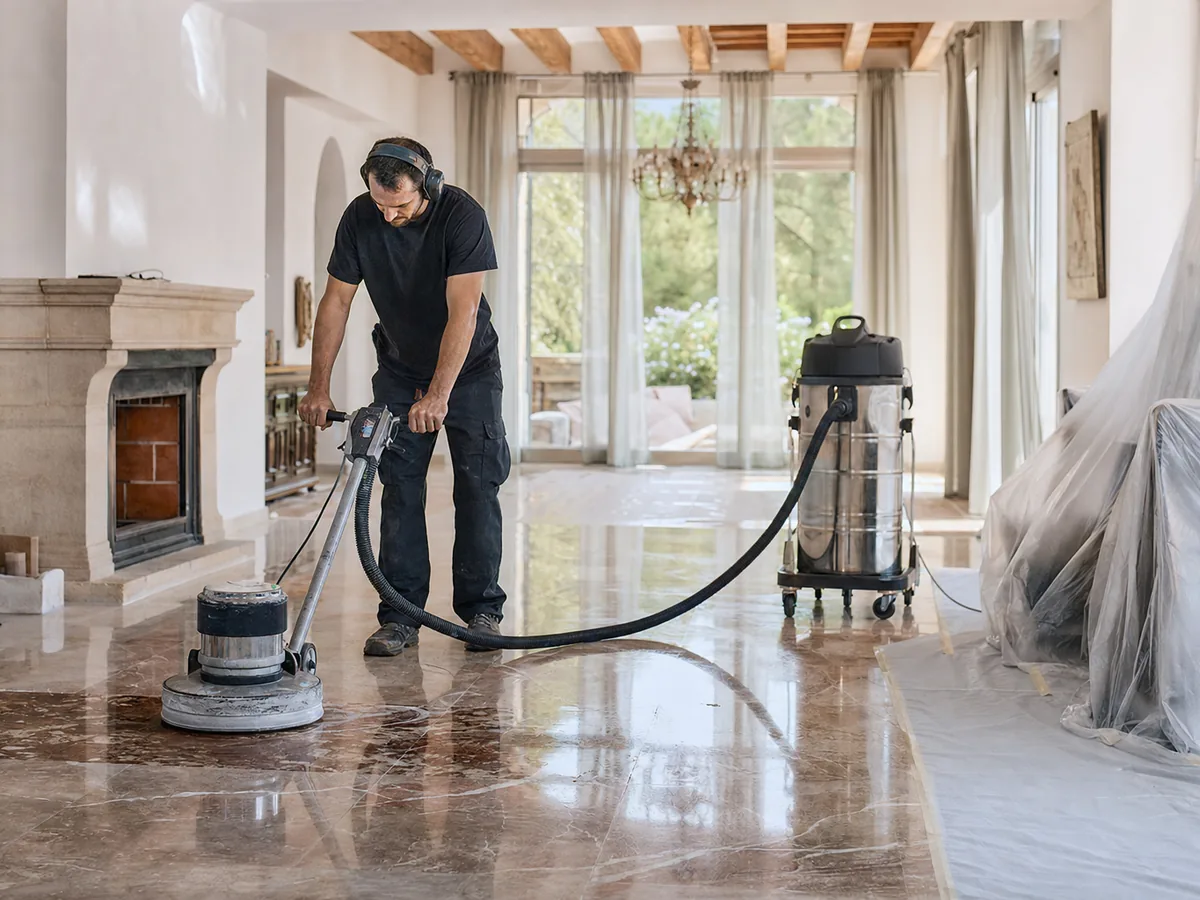
Dust-free polishing is either of the two methods that prevent particles from remaining in suspension: wet polishing, where water washes away the ground material and turns it into mud, and dry polishing with an industrial vacuum attached to the machine, which captures the particles at the point of generation using high-efficiency filters.
Neither of the two is literally "zero dust". Wet polishing removes airborne dust completely, but it generates slurry that has to be collected and that can stain skirting boards if they are not protected. Dry polishing done properly holds back the vast majority of the particles, although a fine residue is always left, which is vacuumed up at the end.
What is literally false is that there is a way of polishing that makes no mess at all. If anyone promises you that, be suspicious.
Wet polishing or dry polishing: which is better for an inhabited house?
| Wet polishing | Dry polishing with vacuum | |
|---|---|---|
| Suspended dust | Virtually zero | Low, retained in filter |
| Waste it generates | Slurry, collected while wet | Fine dust, vacuumed up |
| Risk to skirting boards and furniture | Splashes if not protected | Virtually none |
| Noise | High | High, plus the vacuum cleaner |
| Water usage | Considerable | None |
| Ideal for | Marble, terrazzo, large surfaces | Occupied dwellings, upper floors, stone parquet flooring |
In an occupied house we usually combine the two: wet in the grinding stages, which is where most material is taken off, and dry with extraction in the honing and finishing passes. That keeps the dust under control without flooding the flat. The full technical comparison is in dry or wet floor polishing.
How do you organize a room-by-room polishing without leaving home?
- We empty and work on a complete area, usually the one furthest from the entrance.
- We seal the opening with plastic sheeting and a zip, so the air does not circulate into the rest of the home.
- We protect skirting boards, door frames and anything that cannot be taken out.
- We polish, vacuum and leave that area finished and walkable before we leave.
- The next day we move the furniture into the finished area and open up the next one.
- We always leave a bathroom, a bedroom, and access to the kitchen free.
- Once the last room is done, a general going-over and vacuuming of the whole house.
In a 90 m² flat this is usually done in three or four days, with the family sleeping at home every night. We break the specific timings down in how long it takes to polish a floor.
What do I need to prepare before the team arrives?
It's not much, but it's worth having it done so you don't waste the first morning:
- Empty low cupboards and remove fragile objects from the rooms to be treated.
- Take down pictures and mirrors from the walls in those areas: the vibration is real.
- Leave a power outlet free and, if wet polishing, access to water.
- Plan where heavy furniture will be placed: it can be moved, but it needs a destination.
- Let your neighbours know if you live in a block. The noise of the polisher carries.
- Store plants, cages, and aquariums in the area where work is not being done.
The issue with pets is more important than it seems. The noise from an industrial polisher is very stressful for dogs and cats, and it's reasonable to keep them outside during those days if possible.
How much dust is actually left when you're finished?
A well-executed polish leaves a thin film of dust on high surfaces—shelves, frames, lamps—which can be removed with a damp cloth. The floor is delivered vacuumed and clean. No dust should remain in closed cabinets or sealed rooms.
If the whole house is white when you're finished, it wasn't a dust-free polish: it was a dry polish without vacuuming. And aside from the cleanliness, there's the health problem we were talking about earlier.
The honest comparison is this: it leaves considerably less work afterwards than taking down a partition wall, and considerably more than painting. One normal day of cleaning and the house is ready.
Frequently asked questions about dust-free floor polishing
Is it possible to polish the floor of an apartment without removing all the furniture?
Yes. The usual method in occupied homes is to work room by room, moving furniture to the finished areas without needing to empty the house or rent storage. However, you should remove fragile items, empty low cabinets, and take down pictures from the walls of the area you're working on that day.
How much noise does a floor polishing machine make?
An industrial polisher generates a noise level comparable to that of a hammer drill running continuously, and if you're working dry, you add the noise from the vacuum cleaner. It's clearly audible throughout the house and in neighboring apartments, so in apartment buildings, it's advisable to warn neighbors and limit work to business hours. This is the biggest real drawback of staying home, even more so than the dust.
Can wet polishing damage furniture or wooden skirting boards?
It can if it is not protected properly, because water and slurry splash during the grinding passes. A professional team protects skirting boards, door frames and jambs with plastic and tape before starting, and collects the slurry while it is still wet, before it dries. In homes with delicate joinery or parquet in adjoining rooms it is more sensible to polish dry with extraction.
Is it dangerous for children or someone with asthma to be at home during polishing?
With wet polishing or high-efficiency dust extraction, the risk is low, but in cases of asthma, COPD, or infants, we recommend that these individuals not be in the home during work hours. Polishing dust contains respirable crystalline silica, and although dust collection systems retain most of it, caution is still advised for sensitive individuals.
Can I walk on the floor the same day it's polished?
Yes, a polished and buffed floor can be walked on the same day as vacuuming. The exception is vitrification: if a resin layer is applied, you must wait 12 to 24 hours before walking on it carefully, and 48 to 72 hours before replacing furniture and rugs. Therefore, in occupied homes, vitrification is always planned as the final step.
When IS it advisable to leave home during polishing
- Single-room dwelling or loft, where there is no way to seal off areas.
- People with respiratory conditions or babies in the house.
- When the work includes vitrification, due to drying times.
- Works that combine polishing with chipping or masonry, which is another level of dirtiness.
- Large surfaces with tight deadlines, where the whole house is worked on at once to finish faster.
Do you want to know how it would be done in your house?
Let's take a look. We'll tell you if your home can be polished room by room, which method is best, and how many days it would take. Free of charge and without obligation, anywhere in Mallorca. Call us at 971 503 936 or write to info@projectessastre.com. We are floor polishing professionals in Mallorca for over 50 years, we work with extraction equipment and we plan the floor polishing in Mallorca so you can continue living your normal life at home.