Vitrifying a floor in Mallorca costs between €8 and €15/m² in 2026 as a standalone treatment, or an additional €3 to €6/m² if done as a finishing touch to a polishing process. A 100 m² home will cost between €800 and €1,500 for vitrification alone, and between €1,500 and €2,400 if the floor needs polishing beforehand. The price depends on the material, the condition of the flooring, and the total surface area.
Searching for the price of floor vitrification online often returns calculators that ask for your email address and give you a huge price range. Here, there's no calculator: these are the figures we used for our quotes in Mallorca in 2026, showing what each price includes and what's charged separately.
We've been vitrifying floors on the island for over 50 years, so the price ranges are based on invoices, not a national average. To compare industry benchmark prices, you can check the construction price generator from CYPE, and the trend in material and labour costs is published by the National Institute of Statistics.
How much does it cost to vitrify a floor in Mallorca in 2026?
Vitrifying a floor in Mallorca costs between €8 and €15/m² in 2026 if the floor is already smooth and only needs treatment. If polishing is required beforehand, vitrification is added to the polishing cost as a finishing touch, increasing the price by between €3 and €6/m².
| Starting situation | Job | Price 2026 | 100 m² house |
|---|---|---|---|
| Smooth floor, just off | Vitrified over the existing floor | 8-15 €/m² | 800-1.500 € |
| Floor with stripes and wear | Polishing + vitrification as a finish | 15-24 €/m² | 1.500-2.400 € |
| Floor with open joints | Polishing + joint filling + vitrification | +0.5-1 €/m² | +50-100 € |
| Hotel or community, +300 m² | Price per volume | From €7-9/m² | — |
The difference between the first and second rows is where people go wrong when comparing quotes. A vitrified finish over a scratched floor seals the scratch inside: it remains shiny with the defect underneath, forever. That's why a quote of €9/m² and another of €20/m² can both be honest and describe different work.
What does the price of vitrification include and what is charged separately?
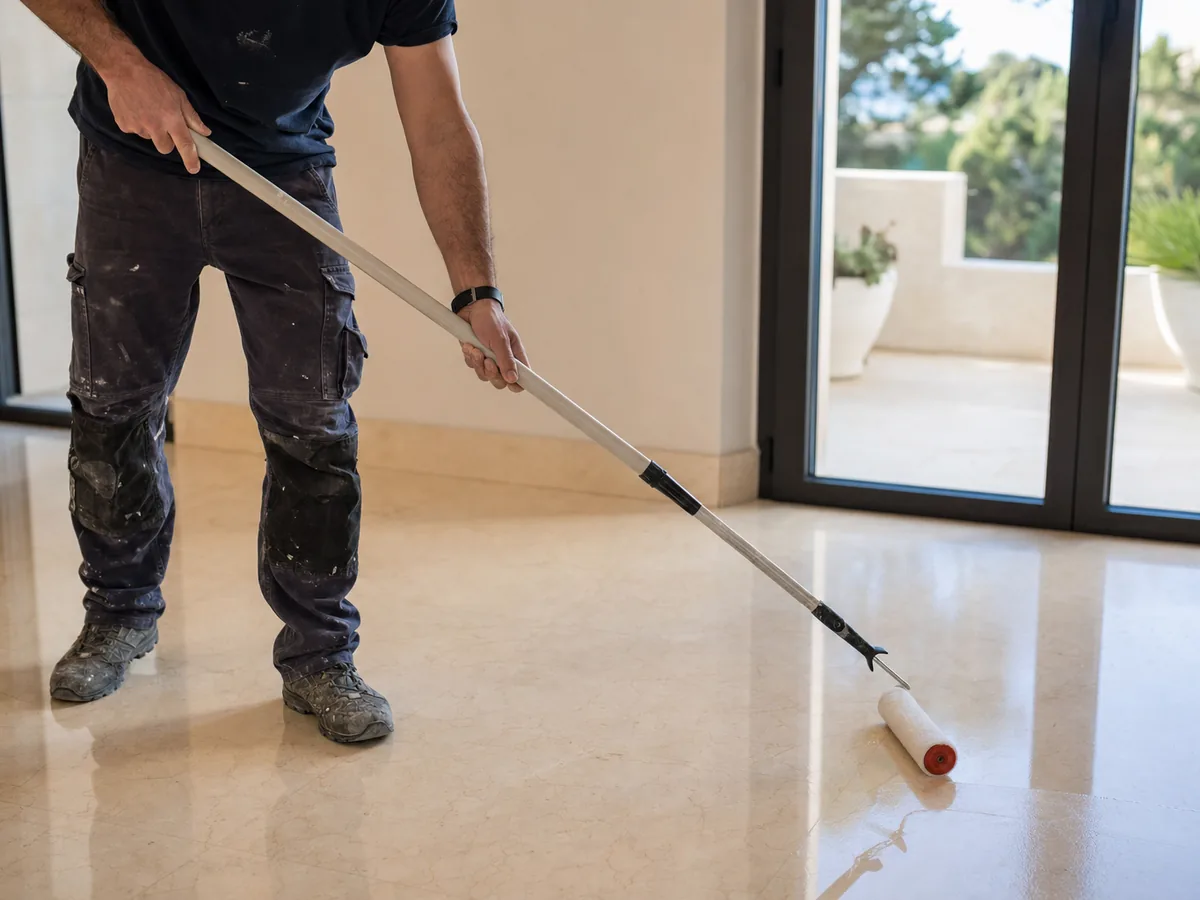
This includes preparing the surface, applying the product in the number of coats the material calls for, and controlled drying. The following are charged separately, and it is worth asking about them before signing:
- Stripping waxes and accumulated old products costs between €2 and €4/m².
- Filling joints in old terrazzo floors costs between €0.5 and €1/m².
- The removal and replacement of baseboards when they are in the way.
- Stairs and steps, which are priced per linear meter and not per square meter.
- Commuting, if the job is small and far away.
We do not charge for the visit or the quote. We do charge for the stripping, because it is real work: a house where wax has been applied for years has a film that has to be removed in full before the vitrification will take hold.
Is vitrifying the same as crystallising or buffing?
No, and the confusion is costly because the three treatments cost different amounts and last different durations. Vitrifying means applying a product that forms a hard, transparent layer on top of the floor. Crystallisation means triggering a chemical reaction with the lime in the material, which hardens the surface itself; how much it costs to crystallise a floor is in the table below. Buffing means bringing out the shine mechanically, without adding anything.
| Treatment | What it does | Duration | Price 2026 |
|---|---|---|---|
| Vitrification | Adds a hard protective layer | 3-5 years with average transit | 8-15 €/m² |
| Crystallisation | It hardens the material itself | 2-3 years | 6-10 €/m² or +2-4 on polishing |
| Buffing | Brings out shine, does not protect | 1-2 years | 6-10 €/m², which is the price of floor buffing |
| Polishing | Reduces and corrects defects | 8-15 years | €10-25/m² |
Ten years out, the sums look different. A polishing with vitrification at €20/m² that lasts a decade works out cheaper than buffing every two years at €8/m², which is four interventions and €32/m². And in between there is something you do not pay in money: every buffing means emptying the room again.
There is a limitation nobody mentions: granite does not crystallise, because it has no lime to react with. On granite only polishing, mechanical buffing and sealing are possible. We set it out in the differences between floor polishing and vitrification.
How long does a vitrified floor last before needing to be retreated?
Between three and five years in a home with normal traffic, and between one and two years in a commercial space or hotel corridor. The vitrified layer wears down first in high-traffic areas, so the sign isn't that the floor loses its shine entirely, but rather that dull patches appear in walkways.
When that time comes, there's no need to polish again. The remaining layer is stripped off and reapplied at the price of vitrification, not polishing. That's precisely the saving that vitrification justifies: protecting expensive work so it doesn't have to be redone.
Extending the lifespan is simple and depends on three things: a doormat at the entrance to keep sand out, mopping with neutral soap (not ammonia or hydrochloric acid), and felt pads under the chair legs. We'll expand on this in how to keep the shine on a vitrified floor for longer.
What makes a vitrification quote more expensive?
The price of vitrifying a floor is determined primarily by its condition. Next, in this order: the square footage, because the machinery setup is divided; the presence of old wax, which requires stripping; stairs and corners, which require manual work; and access, because moving equipment to a third floor without an elevator takes time.
The material also matters. Marble and terrazzo take well to floor vitrification in Mallorca; granite, as we mentioned, is a different story; and terracotta requires specific products and more hands, because it absorbs a lot.
A local factor: in coastal homes, salt deposits on the surface, requiring thorough washing before applying any product. If the product is applied over salt, the coating won't adhere properly and will flake off within a few months. This is the most frequent cause of vitrified finishes failing in the first line of construction.
Frequently asked questions about the price of floor vitrification
How much does it cost to vitrify a 100 square meter floor in Mallorca?
Between €800 and €1,500 if the floor is smooth and only needs treatment, at a rate of €8 to €15/m² in 2026. If the flooring has scratches or wear and needs polishing first, the combined polishing and vitrification cost ranges from €1,500 to €2,400. For large surfaces, such as hotels or residential complexes larger than 300 square meters, the unit price drops to €7-€9/m².
Which is better, vitrifying or crystallising a floor?
It depends on the material and the use. Vitrification adds a protective layer, lasts three to five years and protects better against stains and scuffs, so it fits floors with traffic. Crystallisation hardens the surface itself, gives a more natural mirror shine and lasts two to three years, and works well on marble and terrazzo in homes. Granite cannot be crystallised because the product has no lime to react with.
Does the floor need to be polished before vitrifying it?
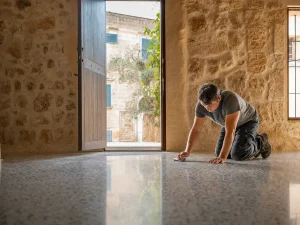
Only if it has scratches, rings, or unevenness. Vitrification doesn't correct imperfections; it seals them under a transparent layer, so a scratched floor will be both shiny and scratched. If the floor is smooth and just dull, it can be vitrified directly after a thorough cleaning. The quick way to tell is to look at the floor against the light from a corner, with the light hitting it at an angle.
How long does it take for a vitrified floor to dry and when can it be walked on?
You can walk on it with socks 6-8 hours after the last coat and with normal shoes after 24 hours. For heavy furniture and carpets, it's best to wait three to five days, because the layer continues to harden even if it feels dry to the touch. In winter and with high humidity, which in Mallorca is common between November and February according to data from the State Meteorological Agency, those deadlines are extended by one day.
When vitrification is NOT worthwhile
If the floor has rising damp, no. The moisture pushes up from below, the layer lifts in bubbles and you will have paid twice. If the floor is full of broken or loose tiles, no either: the substrate gets fixed first. And if you are going to renovate the home in less than a year, wait, because the works will scratch what you have just protected.
There is one more point worth mentioning: on outdoor floors that get wet, vitrifying increases the risk of slipping. The Technical Building Code requires specific slip resistance classes for these areas, as detailed in the Basic Document on Safety of Use and Accessibility. On terraces and pool edges, the correct solution is the opposite: to add texture with bush hammering.
Ask for a real quote, not an estimate
We will go and look at the floor, measure, and tell you whether it needs polishing or whether vitrifying is enough, which is the question almost all of the price depends on. The visit and the quote are free and with no obligation, anywhere in Mallorca. Call 971 503 936 or write to info@projectessastre.com. We are floor polishing professionals in Mallorca for more than 50 years, and here you have our service of floor vitrification in Mallorca.