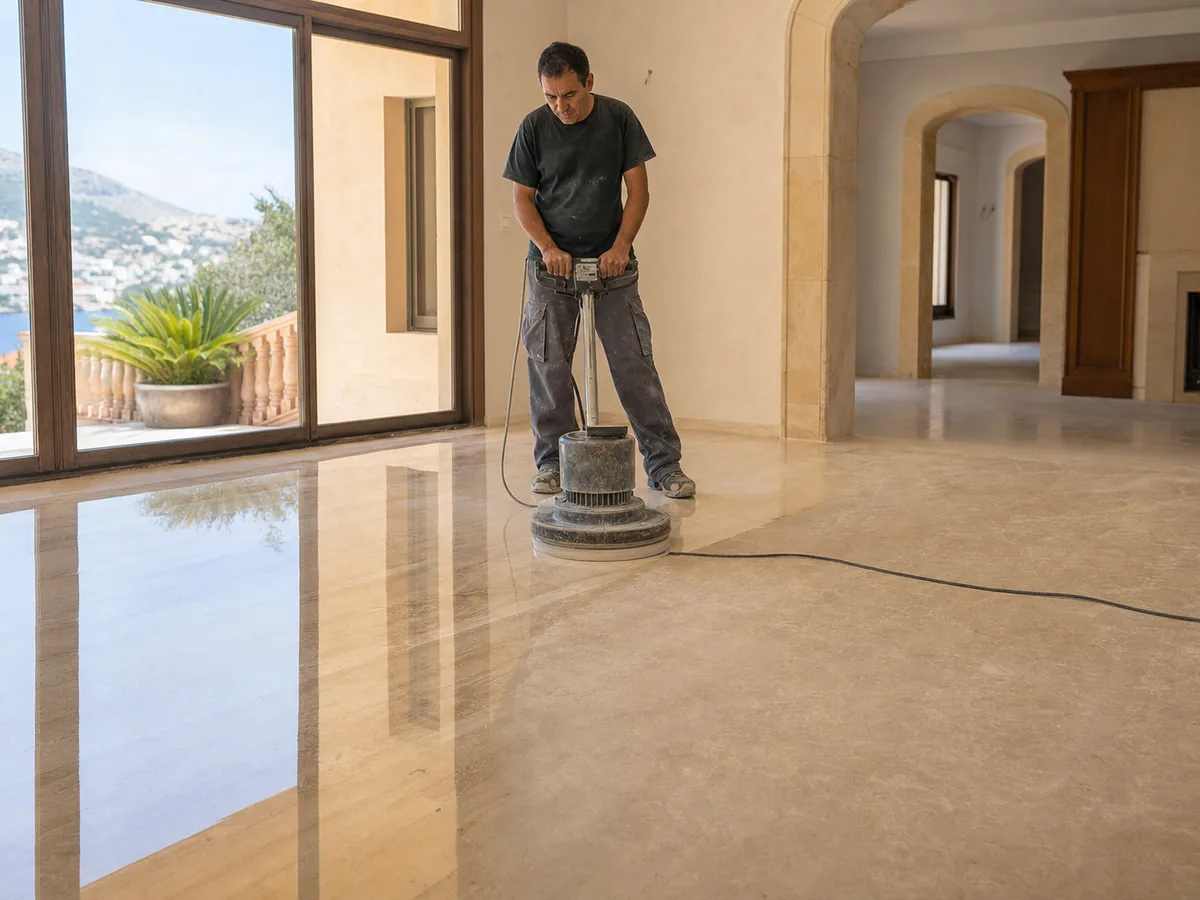
A 90 m² flat is polished in 3 or 4 working days. The average output of a professional team is between 25 and 40 m² a day on a full polish, and rises to 80-120 m² a day if it is only buffed. The floor can be walked on the same day if it finishes with buffing; if it is vitrified you have to wait 12 to 24 hours to walk on it and up to 72 to put furniture back. The material and the starting condition matter more than the square metres.
Nobody books a floor polishing job without doing this sum in their head: how many days will my house be upside down?
The problem is that there is barely an answer online. Almost everything you find talks about sanding parquet, which is another trade and other timings. So here are the real timings for polishing marble, terrazzo, granite and concrete, measured on site and not taken from a catalogue.
How long does it take to polish a floor?
Polishing a floor takes between 1 and 6 working days in a private home, depending on the area and the condition. As a quick reference: up to 40 m², one day; from 40 to 80 m², two or three; from 80 to 120 m², three or four; above 150 m², five or more. To that you have to add the waiting times for the finish, which are not working days but are days when the floor dictates how you use the house.
| Surface | Complete polishing | Buffing only |
|---|---|---|
| Up to 40 m² | 1 day | Half day |
| 40-80 m² | 2-3 days | 1 day |
| 80-120 m² | 3-4 days | 1 day |
| 120-200 m² | 4-6 days | 1-2 days |
| More than 200 m² | From 6 days | 2-3 days |
A working day is not always a calendar day. In occupied homes the work is done room by room and the hours are sometimes fitted around the building's rules, so a three-day job can be spread over four.
What determines whether a polishing takes two days or six?
It depends above all on the starting condition, not the square metres. Marble that only needs honing and shine is sorted with one light grinding pass. Terrazzo with open joints and pieces at different heights has to start with a coarse grit, and every extra pass is time.
These are the factors that most lengthen a deadline, in order of actual impact:
- Depth of damage. Surface scratches versus wear that has reached the aggregate.
- Level difference between pieces. Levelling the heights between pieces means grinding down far more material.
- Previous repairs. Broken pieces, cracks, or joints that need to be resin-coated and cured before proceeding.
- Old layers. Accumulated wax, paint residue, or adhesives from a removed carpet.
- The geometry of the space. Lots of corners, pillars and narrow corridors halve the output.
- The furniture. If it has to be moved every day, that is a good hour a day not spent polishing.
Point 3 is the one that blows the most quotes. A crack that has to be resined needs its curing time, and during that time the job stops.
How many square metres are polished per day?
A professional team polishes between 25 and 40 m² a day on a full home polish, and between 40 and 70 m² a day on large open surfaces where the machine can work without interruption. On buffing with no grinding, output rises to 80-120 m² per day.
This wide range is explained by the difference between an empty 60 m² living room and a 60 m² apartment divided into seven rooms. In the former, the machine never stops. In the latter, half the time is spent protecting, moving, and repositioning items.
When a quote promises 100 m² of complete polishing in one day in a normal house, either there are several teams, or something is going to be done quickly.
How long does polishing take depending on the floor material?
| Material | Days per 100 m² | Why |
|---|---|---|
| Marble | 3-4 | Soft stone, good output, many honing passes |
| Terrazzo | 3-5 | It depends on the aggregate; large-grained ones are slower |
| Granite | 4-6 | Very hard, more passes and more disc wear |
| Polished concrete | 4-6 | Irregular surface to begin with, a lot of grinding |
| Baked clay | 3-5 | Soft but very porous, needs treatment afterwards |
| Natural stone from Mallorca | 4-6 | Marés and Santanyí are irregular and call for hand work |
Granite is the material that surprises people the most: it scratches very little precisely because it is extremely hard, and that same hardness is what makes polishing it take longer and wear down more tools. The upside is that the result lasts a very long time.
How long do you have to wait before walking on it, putting furniture back and mopping?
A floor finished with polishing and buffing can be walked on the same day. A crystallised floor too. A vitrified floor needs 12 to 24 hours before walking on it carefully and 48 to 72 hours before putting heavy furniture and rugs back.
| Finish | Walking on it | Furniture and rugs | First mopping |
|---|---|---|---|
| Polishing + buffing | Same day | 24 h | 7 days |
| Polishing + crystallisation | Same day | 24-48 h | 7 days |
| Polishing + vitrification | 12-24 h | 48-72 h | 10-15 days |
The bit about the first mopping is the advice most often ignored and the one that ruins the most results. A newly treated floor needs the finish to settle, and putting water and detergent on it in the first few days shortens the life of the work. A week of sweeping and a dry mop is not that much to ask.
In Mallorca there is also an environmental factor: with the high relative humidity of summer in coastal areas, the drying times for vitrification get longer. The humidity data by district published by the AEMET are a good indicator of how much margin to leave, and in August it is normal to add a few hours to what the product data sheet says.
How much do vitrification or crystallisation add to the total time?
Crystallisation adds between half a day and a full day to the job, because it is applied over the already polished floor and on the same visit. Vitrification adds between one and two days of application, plus the drying times between coats, which are usually 4 to 8 hours each.
In round numbers, for a 100 m² flat: polishing, 3-4 days; polishing and crystallisation, 4-5 days; polishing and vitrification, 5-7 days counting drying. The difference in time comes with a significant difference in how long it lasts, which we compare in the differences between floor polishing and vitrification.
If you are living in the house while it is done, vitrification is the one that gets in the way most, and that is why it is always planned for the end and in the area that gets walked on least.
Why does it take longer in a building entrance than in an apartment?
Because it cannot be closed off. In a block the work is organised in halves so that residents always have a way through, and working like that cuts the daily output almost in half. An entrance hall with a staircase that would be done in two days in an empty building takes four in an occupied one.
The staircase is the other constraint. The steps are polished with a small machine and a good part of the work is by hand, above all on the nosings and the corners. A four-storey flight of stairs can take as long as the whole entrance hall. We set it out in floor polishing in residents' associations, entrance halls and staircases.
When is the best time to book a date for floor polishing in Mallorca?
In Mallorca, the schedule for this profession is dictated by the tourist season. The Hotel Occupancy Survey of INE reflects the same pattern in the Balearics every year: occupancy drops away from November and does not recover until April. That is exactly the window in which hotels, apartments and restaurants have their floors done. If you want a date in the autumn, August and September are the time to ask for it.
The volume doesn't help with improvisation either: the College of Technical Architects of Mallorca counted 1,771 renovation projects approved between January and June 2026, 17% more than the previous year, and all those jobs end up needing flooring work at some point. For private customers, the months with the shortest queue are May, June and July.
If you manage a business, the timeframe is even tighter, and we'll discuss that in the floor polishing for hotels and residents' associations in Mallorca.
Frequently asked questions about how long it takes to polish a floor
How long does it take to polish a 100 m² floor?
Polishing 100 m² of flooring takes between 3 and 4 days of work in a house with a standard layout, and between 4 and 6 if the material is granite or concrete, or if there have been previous repairs. If it is also vitrified, one or two more days of application and drying time between coats must be added, bringing the total job to around a week.
How long does it take for a freshly polished floor to dry?
A polished and buffed floor doesn't need drying: it can be walked on as soon as it's vacuumed, the same day. Drying is only necessary with vitrified finishes, where each layer of resin needs between 4 and 8 hours, and the entire process requires 12 to 24 hours before walking on it. Ambient humidity and temperature extend these drying times, especially in summer in coastal areas.
Is it possible to polish a floor in just one day?
Yes, provided the surface area does not exceed 35 or 40 m² and the floor needs no repairs or deep grinding. Studios, small flats and individual rooms can be finished in a single day. Above that size, promising a complete polish in one day usually means skipping refining passes, and that shows in the finish within a few weeks.
How long does it take to polish the staircase of a residential building?
A four-storey flight of stairs takes between 2 and 4 working days, because a good part of the work is done with a small machine and by hand on the steps, nosings and corners. If a permanent way through has to be left for residents as well, it takes longer. It is normal for the staircase to take as long as the whole entrance hall, even though it has fewer square metres.
Do I have to empty the house before they start polishing?
There's no need to empty it completely. The usual approach is to work room by room, moving furniture to the finished areas so you can continue living in the house. It is advisable to remove fragile items, take down pictures, and empty low cabinets in the area where you'll be working each day. We explain this in detail in our guide on polish the floor without dust.
How many days would that be in your case?
It depends on the type and condition of your flooring, and that can't be accurately determined over the phone. We'll come and take measurements, and provide you with a written estimate and timeframe, free of charge. Call us at 971 503 936 or write to info@projectessastre.com. We are polishing and vitrification company in Mallorca for more than 50 years, and in our floor polishing and treatment service we work to a fixed schedule from day one: you will know when we start and when we finish.